Fellow Clarion dudes Eric and Trent have posted their list of books read in 2006, so I thought I'd include my complete, unexpurgated list. The astute reader will notice a few books on my Best of 2006 list that aren't included in the following list. Explanation: I hadn't completely finished those books, but I'd read enough of them to know they'd make my Best of 2006 list. So there. Cheating? Naw! Remember, my list, my rules.
Also, don't be too impressed. 100 books really isn't that much, especially when you consider that several of them are YA or juv. books and others were Books on Tape/CD. I still count 'em, though. I drive around a good bit on my book rounds, so it just makes sense to listen to stuff as I drive. So 100 isn't really all that impressive. (I sure ain't no Harriet Klausner.)
JANUARY
Harry Potter and the Order of the Phoenix (YA 2003) – J.K. Rowling
Crispin – The Cross of Lead (YA 2002) – Avi
No Country for Old Men (2005) – Cormac McCarthy
Storyteller: Writing Lessons and More from 27 Years of the Clarion Writers' Workshop (NF 2005) – Kate Wilhelm
Diary (2003) – Chuck Palahniuk
The Colorado Kid (2005) – Stephen King
Cell (2006) – Stephen King
Vellum (2005) – Hal Duncan
To Say Nothing of the Dog (1998) – Connie Willis
Only You Can Save Mankind (Juv 1992/2004 reissue) – Terry Pratchett
FEBRUARY
Reading Lolita in Tehran: A Memoir in Books (NF 2003) –Azar Nafisi
House of Leaves (2000) – Mark Z. Danielewski
Orchard (2003) – Larry Watson
The Handmaid's Tale (1985) – Margaret Atwood
Horror: Another 100 Best Books (NF 2005) – Stephen Jones & Kim Newman, eds.
Life of Pi (2002) – Yann Martel
Orphans of Chaos (2005) – John C. Wright
The Lincoln Lawyer (2005) – Michael Connelly
Their Eyes Were Watching God (1937) – Zora Neale Hurston
Cold Hand in Mine: Strange Stories (1975) – Robert Aickman
The Thief (YA 1996) – Megan Whalen Turner
MARCH
Saturday (2005) – Ian McEwan
Understanding the Bible (NF 1999) – John R.W. Stott
The Bottoms (2000) – Joe R. Lansdale
Night (NF 1959) – Elie Wiesel
Bankok 8 (2003) – John Burdett
Southern Comfort: A Charitable Anthology (2005) – S.A. Parham & W. Olivia Race, eds.
So You Want To Be a Wizard (YA 1983) – Diane Duane
Coldheart Canyon (2001) – Clive Barker
The Brief History of the Dead (2006) – Kevin Brockmeier
APRIL
Air (2004) – Geoff Ryman
The Witches (Juv/YA 1983) – Roald Dahl
Midnighters 2: Touching Darkness (YA) – Scott Westerfeld
The Shadow at the Bottom of the World (2005) – Thomas Ligotti
Tuck Everlasting (Juv/YA 1975) – Natalie Babbitt
The Two Sams: Ghost Stories (2003) – Glen Hirshberg
Leo: A Greyhound's Tale (YA 2003) – Cindy Victor
MAY
The Peacemaker: A Biblical Guide to Resolving Personal Conflict (NF) – Ken Sande
Blood Meridian (1985) – Cormac McCarthy
X-Men: Dark Mirror (2006) – Marjorie M. Liu
All You Need Is Ears – The Inside Personal Story of the Genius Who Created The Beatles (NF 1979) – George Martin with Jeremy Hornsby
Blue Like Jazz (NF 2003) – Donald Miller
Don Quixote (1605) – Cervantes, trans. Edith Grossman
The Thief Lord (YA 2000) – Cornelia Funke
The Empire of Ice Cream (2006) – Jeffrey Ford
The Adventures of Huckleberry Finn (1884) – Mark Twain
1066: The Hidden History in the Bayeux Tapestry (NF 2005) – Andrew Bridgeford
The Keys to the Kingdom – Book 1: Mister Monday (YA 2003) – Garth Nix
JUNE
The Spiderwick Chronicles, Book 1: The Field Guide (Juv/YA 2003) – Holly Black and Tony DiTerlizzi
1776 (NF 2005) – David McCullough
The Amulet of Sanmarkand (YA 2003) – Jonathan Stroud
Cold Hit (2005) – Stephen J. Cannell
His Majesty's Dragon (2006) – Naomi Novik
Armageddon Summer (YA 1998) – Jane Yolen and Bruce Coville
The Year's Best Fantasy and Horror Eighteenth Annual Collection (2005) – Ellen Datlow, Kelly Link, Gavin J. Grant, eds.
The Home-Based Bookstore (NF 2006) – Steve Weber
A Drink Before the War (1994) – Dennis Lehane
Cover Story – The Art of John Picacio (NF 2006)
JULY
The Book Thief (YA 2006) – Marcus Zusak
lost boy lost girl (2003) – Peter Straub
The Jaguar Hunter (1987) – Lucius Shepard
Prince Caspian (YA 1951) – C.S. Lewis
Jane Eyre (1847) – Charlotte Bronte
Horror: 100 Best Books (NF 1988) – Stephen Jones and Kim Newman, eds.
By a Spider's Thread (2004) – Laura Lippman
Ghost Stories of an Antiquary (1904) – M.R. James
Shadow Touch (2006) – Marjorie M. Liu
AUGUST
In the Forest of Forgetting (2006) – Theodora Goss
Addictions: A Banquet in the Grave (NF 2001) – Edward T. Welch
The Crying of Lot 49 (1965) – Thomas Pynchon
True History of the Kelly Gang (2001) – Peter Carey
When Life and Beliefs Collide (NF 2001) – Carolyn Custis James
Gun, with Occasional Music (1994) – Jonathan Lethem
Shadows and Silence (2000) – Barbara Roden, Christopher Roden,
eds.
SEPTEMBER
The Last of the O-Forms and Other Stories (2005) – James
Van Pelt
Manhunt (NF 2006) – James L. Swanson
The Husband (2006) – Dean Koontz
Rosemary's Baby (1967) – Ira Levin
Everything's Eventual: 14 Dark Tales (2002) – Stephen King
When People are Big and God is Small (NF 1997) – Edward T.
Welch
The Eyre Affair (2001) – Jasper Fforde
Midnighters 3: Blue Noon (YA 2006) – Scott Westerfeld
OCTOBER
Hans Christian Andersen Fairy Tales (2005 reissue) - trans. Tiina Nunnally
No Good Deeds (2006) – Laura Lippman
James Tiptree, Jr.: The Double Life of Alice B. Sheldon (NF 2006) – Julie Phillips
A Scanner Darkly (1977) – Philip K. Dick
Never Let Me Go (2005) - Kazuo Ishiguro
Shriek: An Afterword (2006) – Jeff VanderMeer
NOVEMBER
Kafka on the Shore (2005) - Haruki Murakami
The Road (2006) – Cormac McCarthy
London (NF 2004) – A.N. Wilson
The God Who is There (NF 1968) – Francis A. Schaeffer
The World Is Flat: A Brief History of the Twenty-first Century (NF 2005) – Thomas L. Friedman
The Five Love Languages (NF 1992) – Gary Chapman
DECEMBER
Twilight (YA 2005) – Stephenie Meyer
Reading Like a Writer: A Guide for People Who Love Books and for Those Who Want to Write Them (NF 2006) – Francine Prose
Best New Fantasy (2006) – Sean Wallace, ed.
Sharpe's Prey (2002) – Bernard Cornwell
Searching for God Knows What (NF 2004) – Donald Miller
Lolita (1955) – Vladimir Nabokov
To Own a Dragon (NF 2006) – Donald Miller & John MacMurray
Echo Park – Michael Connelly (2006)
Wednesday, January 10, 2007

Monday, January 08, 2007
Wheels
Just for fun, here are our two new cars, both in need of a wash.

My Toyota Matrix
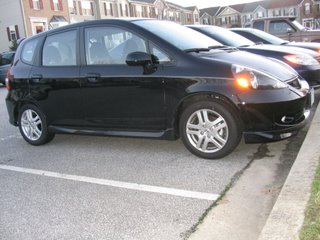
Cindy's Honda Fit
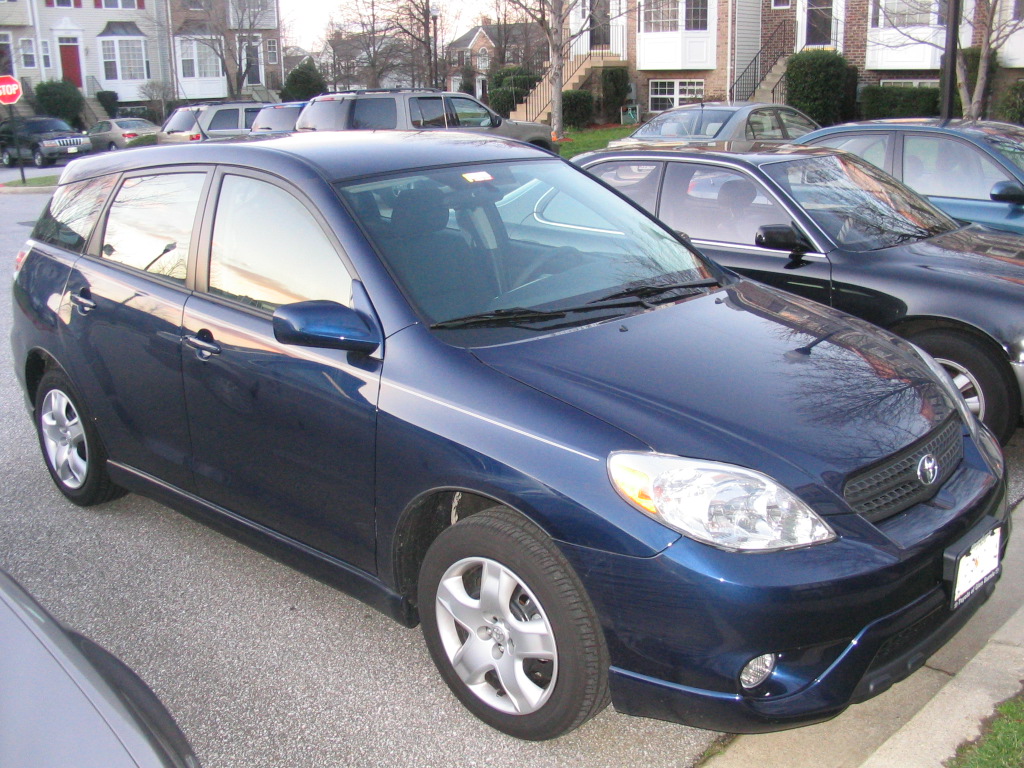
My Toyota Matrix

Cindy's Honda Fit
Another Look
Still revising my YA novel (Chapter 9 out of 25, not 20 as I incorrectly stated in an earlier post) and making some interesting discoveries. I'm sure every novelist faces this, but since this is only my second attempt (and the first one anyone will ever see beyond the confines of my house), it's a real eye-opener for me. Of course what I'm talking about is the realization that the novel might not be about what I originally thought it was about.
That's both exciting and unsettling. It's exciting in that I'm discovering deeper themes, more complexities in my characters, making for (hopefully) a stronger story. But it's a little unsettling knowing that maybe this great scene/confrontation/battle I wrote into the first draft might be drastically changed or maybe even scrapped. In a way, I guess it's like the old adage about sculpting David from a block of marble. How do you sculpt David? Cut away everything that's not David. Even if that means cutting away a pretty cool piece that looks exactly like Paul or Moses.
But save that piece of Paul, that bust of Moses. They might come in handy some day.
That's both exciting and unsettling. It's exciting in that I'm discovering deeper themes, more complexities in my characters, making for (hopefully) a stronger story. But it's a little unsettling knowing that maybe this great scene/confrontation/battle I wrote into the first draft might be drastically changed or maybe even scrapped. In a way, I guess it's like the old adage about sculpting David from a block of marble. How do you sculpt David? Cut away everything that's not David. Even if that means cutting away a pretty cool piece that looks exactly like Paul or Moses.
But save that piece of Paul, that bust of Moses. They might come in handy some day.
Thursday, January 04, 2007
Research, Getting Distracted and the Demise of the Public Library System
I'm in the middle of revising my YA novel (Well, not quite in the middle --- I'm on Chapter Seven of twenty.) and found I had to make a decision regarding on how much technology I wanted in my story's setting (specifically in this particular kitchen scene). Although my novel is not set in Colonial America, I found lots of helpful information in William Chauncy Langdon's Everyday Things in American Life 1607-1776. There's also a companion volume that covers 1776-1876, which I also own. Both include great information and are also fun to read.
They're also hard to find. Your local library may have them, or then again, they may not. I bought both copies for fifty cents each at my local library's ongoing library discards sale. (If I ever find this Langdon title, I can buy one of those big-screen TVs I've been drooling over.) For more on the current state of libraries in general, check out this from John's blog.
And speaking of books, one of the more dangerous parts of selling used books is running across books that you thought you were going to sell, but decided you just can't part with. (What if I never see the book again? TRAGEDY!) So yesterday I picked up The Golden Ratio: The Story of PHI, the World's Most Astonishing Number and decided to keep rather than sell it.
Now I don't know spit about mathematics, but I figured a whole book devoted to the number phi, or 1.6180339887 and counting (not to be confused with pi, which is 3.14159 and counting. Both numbers might even have as many digits as there are Nora Roberts novels.) must be worth a look. So I read the first sentence, including a quote from British physicist Lord Kelvin:
When you cannot express it in numbers, your knowledge is of a meager and unsatisfactory kind.
Well, that flew all over me.
So I started reading the thing.
What can I say? I love my job. I'll get back to you in, oh, about 1.6180339887 days.
They're also hard to find. Your local library may have them, or then again, they may not. I bought both copies for fifty cents each at my local library's ongoing library discards sale. (If I ever find this Langdon title, I can buy one of those big-screen TVs I've been drooling over.) For more on the current state of libraries in general, check out this from John's blog.
And speaking of books, one of the more dangerous parts of selling used books is running across books that you thought you were going to sell, but decided you just can't part with. (What if I never see the book again? TRAGEDY!) So yesterday I picked up The Golden Ratio: The Story of PHI, the World's Most Astonishing Number and decided to keep rather than sell it.
Now I don't know spit about mathematics, but I figured a whole book devoted to the number phi, or 1.6180339887 and counting (not to be confused with pi, which is 3.14159 and counting. Both numbers might even have as many digits as there are Nora Roberts novels.) must be worth a look. So I read the first sentence, including a quote from British physicist Lord Kelvin:
When you cannot express it in numbers, your knowledge is of a meager and unsatisfactory kind.
Well, that flew all over me.
So I started reading the thing.
What can I say? I love my job. I'll get back to you in, oh, about 1.6180339887 days.
Wednesday, January 03, 2007
Catching Up/Catching Cold
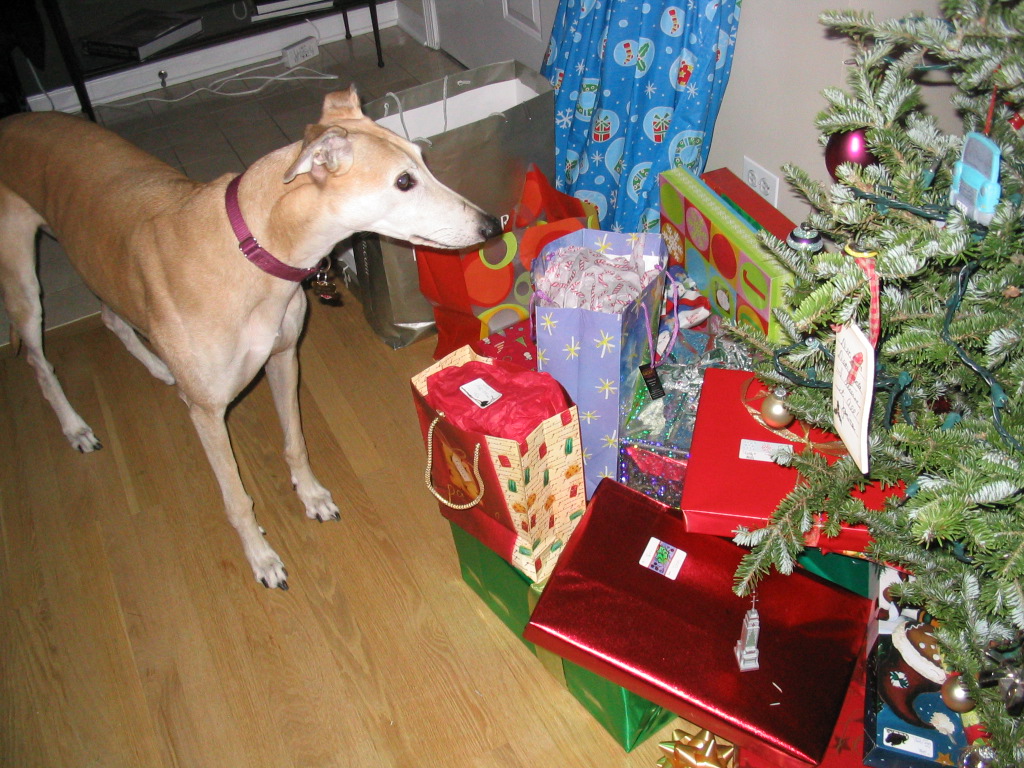
Cindy, Bullet and I had a great trip to an unseasonably warm Chicago to visit Cindy's sister Jan and her husband Pete (and their dog Sammy). Cindy's parents were there too and lots of loot was exchanged. We also had a great New Year's at John's house (Thanks, John!).
But once all the hoopla ended, I got sick. But at least that gives me a little time to catch up on reading, movies, etc.
More stuff to follow including a full loot report.
Wednesday, December 20, 2006
Christmas in Chicago
Early tomorrow morning, Cindy and Bullet and I will load up the Matrix and head for Chicago, where Cindy's sister Jan and her husband Pete live. (We haven't decided yet if Bullet will drive or sleep first.)
I hope everyone has a safe, wonderful holiday! Have fun, kids!
I hope everyone has a safe, wonderful holiday! Have fun, kids!
Tuesday, December 19, 2006
M. Rickert Mania
Not that much is known about M. Rickert, one of my favorite writers these days. Ah, but John Joseph Adams (The Slush God) has just conducted an excellent interview with Rickert at Strange Horizons. Read it. Then buy Rickert's new book Map of Dreams. Then buy it for friends. Repeat.
A Few Thoughts on Holiday Music
You'd think after fifteen years of teaching band, fifteen (or more) holiday concerts, I'd just about had it up to the gills with holiday music. But for some reason, I still enjoy listening to most of it. (Then again, I guess there's someone out there who enjoys root canals and reruns of Joanie Loves Chachi.)
And there's plenty to choose from. Just on XM Radio, there's six different holiday stations. After listening for a few days, I've made some interesting observations:
First, we need national (or maybe international) standards for who gets to sing "O Holy Night" and who doesn't. It's hands-down my favorite holiday song and I know many others who share that feeling. It's a song that requires a great voice and a tasteful rendering. Not everybody can or should try it. Yet it seems like everybody has recorded a version of the song. Oddly enough, most of the versions I've heard are from country singers. I began to wonder why and I think I've got it figured out:
I can picture all these country singers sitting around the bar after the Country Music Association Awards or some such event, mad as all get-out that Johnny Cash (who's been dead for three years) is still releasing better stuff than most everybody else. After a few rounds, somebody no doubt proclaimed, "Well, hell, he can't do 'O Holy Night'! I'm gonna do it!" Which led some other singer to say, "Well, if he can do it..." and on and on.
Now from what I've heard on the country stations, only Martina McBride gets to sing "O Holy Night." She can pull it off. As much as I like Willie....no, sorry. And Dolly, you know I love ya, but....nope. George Jones? Hey, buddy...there's lots of stuff you shouldn't try anymore.
Second, after listening to the traditional holiday station, I assumed that Johnny Mathis must've spent a good six or seven years of his life recording Christmas music. I mean the dude is all over the place. So I went to Amazon and typed in Johnny Mathis Christmas and got 62 matches. Of course you know, several of those are overlaps, similar editions, reissues, etc. He didn't really record 62 Christmas albums. (Just so you know, which you probably already do.)
But Mathis is a real lightweight. Perry Como and Christmas got 70 matches. Sinatra and Christmas, 115 matches. But they're all twerps compared to Bing Crosby. 296 matches! Again, he didn't record anything close to that many Christmas albums, but come on! Man. I'll bet David Bowie wishes they'd done more duets.
So whatever you're listening to this holiday season, have a great one.
Now Playing: "O Little Town of Bethlehem" – Emmylou Harris
And there's plenty to choose from. Just on XM Radio, there's six different holiday stations. After listening for a few days, I've made some interesting observations:
First, we need national (or maybe international) standards for who gets to sing "O Holy Night" and who doesn't. It's hands-down my favorite holiday song and I know many others who share that feeling. It's a song that requires a great voice and a tasteful rendering. Not everybody can or should try it. Yet it seems like everybody has recorded a version of the song. Oddly enough, most of the versions I've heard are from country singers. I began to wonder why and I think I've got it figured out:
I can picture all these country singers sitting around the bar after the Country Music Association Awards or some such event, mad as all get-out that Johnny Cash (who's been dead for three years) is still releasing better stuff than most everybody else. After a few rounds, somebody no doubt proclaimed, "Well, hell, he can't do 'O Holy Night'! I'm gonna do it!" Which led some other singer to say, "Well, if he can do it..." and on and on.
Now from what I've heard on the country stations, only Martina McBride gets to sing "O Holy Night." She can pull it off. As much as I like Willie....no, sorry. And Dolly, you know I love ya, but....nope. George Jones? Hey, buddy...there's lots of stuff you shouldn't try anymore.
Second, after listening to the traditional holiday station, I assumed that Johnny Mathis must've spent a good six or seven years of his life recording Christmas music. I mean the dude is all over the place. So I went to Amazon and typed in Johnny Mathis Christmas and got 62 matches. Of course you know, several of those are overlaps, similar editions, reissues, etc. He didn't really record 62 Christmas albums. (Just so you know, which you probably already do.)
But Mathis is a real lightweight. Perry Como and Christmas got 70 matches. Sinatra and Christmas, 115 matches. But they're all twerps compared to Bing Crosby. 296 matches! Again, he didn't record anything close to that many Christmas albums, but come on! Man. I'll bet David Bowie wishes they'd done more duets.
So whatever you're listening to this holiday season, have a great one.
Now Playing: "O Little Town of Bethlehem" – Emmylou Harris
Sunday, December 17, 2006
The Year in Review Part Four: Fiction
Although some actually appeared in 2005, these were the most enjoyable new books I read this year. I highly recommend them all. (The order listed is the order I read them.)
His Majesty's Dragon (2006) – Naomi Novik
Just when you think you've seen everything that's been written about dragons, here comes Naomi Novik, placing them in the middle of the Napoleonic Wars. This was an absolutely delightful read, the first in a three-book series with more reported to follow.

In the Forest of Forgetting (2006) – Theodora Goss
Goss writes with an elegant, yet very readable style, the poetic influence clearly seen throughout. All of the stories are good, many are exceptional.
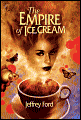
The Empire of Ice Cream (2006) – Jeffrey Ford
What can you say about Ford? Leave your expectations at the door and be prepared for some great weird. An outstanding collection, even better than the remarkable The Fantasy Writer's Assisstant.
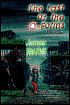
The Last of the O-Forms and Other Stories (2005) – James Van Pelt
It really bothers me that more people aren't familiar with this author. The title story is one of the most emotional reading experiences I had this year. Fantasy, science fiction, horror – James Van Pelt can do it all.
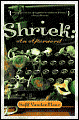
Shriek: An Afterword (2006) – Jeff VanderMeer
Set in the wonderfully realized city of Ambergris, Shriek is a novel about history, war, relationships, perspectives and so much more. VanderMeer delves deep into Ambergris, its history, its people and its culture as Janice Shriek narrates this afterword to "The Hoegbotton Guide to the Early History of the City of Ambergris" (found in VanderMeer's City of Saints and Madmen*), a pamphlet written by Janice's brother, the missing historian Duncan Shriek. But the afterword contains added commentary by Duncan, who has mysteriously returned only to find his sister now missing. I admire so much about VanderMeer's writing – his love of language, compelling characters, a world you can get lost in, a fascinating tale... What else could you ask for?
* It's not really necessary to read City of Saints and Madmen first, but I was glad I'd read "The Hoegbotton Guide" section of that book first.
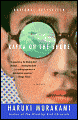
Kafka on the Shore (2005) – Haruki Murakami
Winner of this year's World Fantasy Award, this was my first experience with Murakami. It's a very odd tale mixed with American and Japanese cultural references, fish falling from the sky, talking cats and much more.
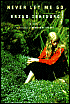
Never Let Me Go (2005) – Kazuo Ishiguro
Like Kafka on the Shore, people continue to debate whether Never Let Me Go is genre or literature. Who cares? It's a tremendous story that's beautifully written, less surreal than Kafka, but in my opinion, packs more of an emotional punch. The novel unwinds slowly, so settle back and savor this one.

The Unblemished (2006) – Conrad Williams
This book just scares the crap out of you, that's all there is to it. Williams is one of horror's most outstanding writers with an extraordinary vision and the skills to haunt you well past sunrise. If you haven't read him, stop reading this and go buy one of his books.
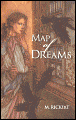
Map of Dreams (2006) – M. Rickert
Fans of Rickert can definitely celebrate this first collection from one of the genre's most talented writers. Don't miss it.
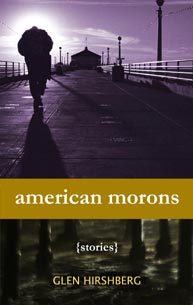
American Morons (2006) – Glen Hirshberg
Hirshberg's quality of writing, his ability to unsettle and fascinate are second to none. Even better than his first collection The Two Sams, which was outstanding.
These books are a little older, but really blew me away (in order of publication):
A Scanner Darkly (1977) – Philip K. Dick
Blood Meridian (1985) – Cormac McCarthy
Gun, with Occasional Music (1994) – Jonathan Lethem
House of Leaves (2000) – Mark Z. Danielewski
lost boy lost girl (2003) – Peter Straub
Air (2004) – Geoff Ryman
Other books I enjoyed (again, in order of original publication):
Don Quixote (1605) – Cervantes, trans. by Edith Grossman
Jane Eyre (1847) – Charlotte Bronte
Ghost Stories of an Antiquary (1905) – M.R. James
Their Eyes Were Watching God (1937) – Zora Neale Hurston
The Crying of Lot 49 (1965) – Thomas Pynchon
The Jaguar Hunter (1987) – Lucius Shepard
Shadows and Silence (2000) – Barbara Roden, Christopher Roden, eds.
Bangkok 8 (2003) – John Burdett
The Colorado Kid (2005) – Stephen King
Vellum (2005) – Hal Duncan
No Country for Old Men (2005) – Cormac McCarthy
The Lincoln Lawyer (2005) – Michael Connelly
Saturday (2005) – Ian McEwan
The Shadow at the Bottom of the World (2005) – Thomas Ligotti
The Year's Best Fantasy and Horror Eighteenth Annual Collection (2005) – Datlow, Link, Grant, eds.
The Brief History of the Dead (2006) – Kevin Brockmeier
The Road (2006) – Cormac McCarthy
Best New Fantasy (2006) – Sean Wallace, ed.
No Good Deeds (2006) – Laura Lippman

His Majesty's Dragon (2006) – Naomi Novik
Just when you think you've seen everything that's been written about dragons, here comes Naomi Novik, placing them in the middle of the Napoleonic Wars. This was an absolutely delightful read, the first in a three-book series with more reported to follow.
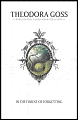
In the Forest of Forgetting (2006) – Theodora Goss
Goss writes with an elegant, yet very readable style, the poetic influence clearly seen throughout. All of the stories are good, many are exceptional.

The Empire of Ice Cream (2006) – Jeffrey Ford
What can you say about Ford? Leave your expectations at the door and be prepared for some great weird. An outstanding collection, even better than the remarkable The Fantasy Writer's Assisstant.
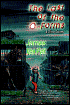
The Last of the O-Forms and Other Stories (2005) – James Van Pelt
It really bothers me that more people aren't familiar with this author. The title story is one of the most emotional reading experiences I had this year. Fantasy, science fiction, horror – James Van Pelt can do it all.
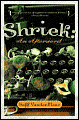
Shriek: An Afterword (2006) – Jeff VanderMeer
Set in the wonderfully realized city of Ambergris, Shriek is a novel about history, war, relationships, perspectives and so much more. VanderMeer delves deep into Ambergris, its history, its people and its culture as Janice Shriek narrates this afterword to "The Hoegbotton Guide to the Early History of the City of Ambergris" (found in VanderMeer's City of Saints and Madmen*), a pamphlet written by Janice's brother, the missing historian Duncan Shriek. But the afterword contains added commentary by Duncan, who has mysteriously returned only to find his sister now missing. I admire so much about VanderMeer's writing – his love of language, compelling characters, a world you can get lost in, a fascinating tale... What else could you ask for?
* It's not really necessary to read City of Saints and Madmen first, but I was glad I'd read "The Hoegbotton Guide" section of that book first.
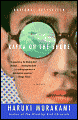
Kafka on the Shore (2005) – Haruki Murakami
Winner of this year's World Fantasy Award, this was my first experience with Murakami. It's a very odd tale mixed with American and Japanese cultural references, fish falling from the sky, talking cats and much more.
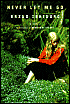
Never Let Me Go (2005) – Kazuo Ishiguro
Like Kafka on the Shore, people continue to debate whether Never Let Me Go is genre or literature. Who cares? It's a tremendous story that's beautifully written, less surreal than Kafka, but in my opinion, packs more of an emotional punch. The novel unwinds slowly, so settle back and savor this one.
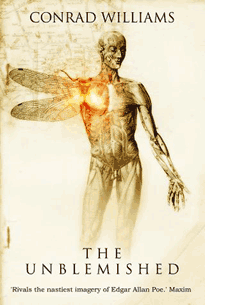
The Unblemished (2006) – Conrad Williams
This book just scares the crap out of you, that's all there is to it. Williams is one of horror's most outstanding writers with an extraordinary vision and the skills to haunt you well past sunrise. If you haven't read him, stop reading this and go buy one of his books.

Map of Dreams (2006) – M. Rickert
Fans of Rickert can definitely celebrate this first collection from one of the genre's most talented writers. Don't miss it.

American Morons (2006) – Glen Hirshberg
Hirshberg's quality of writing, his ability to unsettle and fascinate are second to none. Even better than his first collection The Two Sams, which was outstanding.
These books are a little older, but really blew me away (in order of publication):
A Scanner Darkly (1977) – Philip K. Dick
Blood Meridian (1985) – Cormac McCarthy
Gun, with Occasional Music (1994) – Jonathan Lethem
House of Leaves (2000) – Mark Z. Danielewski
lost boy lost girl (2003) – Peter Straub
Air (2004) – Geoff Ryman
Other books I enjoyed (again, in order of original publication):
Don Quixote (1605) – Cervantes, trans. by Edith Grossman
Jane Eyre (1847) – Charlotte Bronte
Ghost Stories of an Antiquary (1905) – M.R. James
Their Eyes Were Watching God (1937) – Zora Neale Hurston
The Crying of Lot 49 (1965) – Thomas Pynchon
The Jaguar Hunter (1987) – Lucius Shepard
Shadows and Silence (2000) – Barbara Roden, Christopher Roden, eds.
Bangkok 8 (2003) – John Burdett
The Colorado Kid (2005) – Stephen King
Vellum (2005) – Hal Duncan
No Country for Old Men (2005) – Cormac McCarthy
The Lincoln Lawyer (2005) – Michael Connelly
Saturday (2005) – Ian McEwan
The Shadow at the Bottom of the World (2005) – Thomas Ligotti
The Year's Best Fantasy and Horror Eighteenth Annual Collection (2005) – Datlow, Link, Grant, eds.
The Brief History of the Dead (2006) – Kevin Brockmeier
The Road (2006) – Cormac McCarthy
Best New Fantasy (2006) – Sean Wallace, ed.
No Good Deeds (2006) – Laura Lippman
Thursday, December 14, 2006
The Cellar

Richard Laymon's The Cellar (1980), which was included in Stephen Jones and Kim Newman's Horror: The 100 Best Books, has just been re-released in mass market paperback by Leisure. Check it out.
Tuesday, December 12, 2006
The Year in Review Part Three: YA
I read seventeen YA/children's books this year, and although several of those were from either 2005 or 2006, few current books made my list. I find myself starting more and more YA books and not finishing them. I grew fed up with certain series, but decided to start others.
YA is a mixed bag and is becoming a larger mixed bag all the time. I think we're seeing a widening gap between quality YA and no-so-good YA. It seems everyone's writing one (even me). Anyway, of the seventeen titles I read this year, these were the most enjoyable:

The Thief (1996) by Megan Whalen Turner offers a story line we've seen before: A skillful young thief named Gen is released from prison to help a king's scholar steal an ancient mythical stone. Of course it's not just any stone, but one that grants the possessor freedom from death and the perpetual right to rule. Gen is very likable and smart, but he's far from simplistic. The characters in this story are not always who they seem to be and they're always intriguing. Turner challenges younger readers with complex sentences as well as several philosophical and political issues. I have not read the sequels Queen of Attolia or The King of Attolia, but if they're anywhere near as good as The Thief, I'm there.

The Witches (1983) by Roald Dahl is actually more appropriate for younger readers (age 8 – 12), but I had a great time with it, so I'm including it here. While on vacation with his grandmother (who is an expert on witches), a young boy learns all the warning signs for identifying witches, the most dangerous beings in the world. He's forced to put his knowledge to the test when he finds himself in the middle of a witch convention at the hotel where he and his grandmother are staying. The Witches is a fun story that not only entertains, but also teaches that all sorts of people can be very skilled at disguising their real selves.

I started Scott Westerfeld's Midnighters series at the end of 2005 and read the other two books in the trilogy this year, Midnighters 2: Touching Darkness (2005) and Midnighters 3: Blue Noon (2006). The first book, Midnighters: The Secret Hour (2004) is mostly introductory, showing us newcomer Jessica as she moves to the small town of Bixby, Oklahoma, only to discover that she's one of five teenagers who can move in the secret midnight hour, when the rest of Bixby is suspended in time. Only there's plenty of nasties also creeping around during the midnight hour.
The trilogy really takes off in the second book, as the five teenagers try to discover what happened to all the other midnighters throughout history, what makes Bixby susceptible to midnighter activity, and where the next attack of creatures is coming from. And who is the strange old woman they keep seeing? The third book was not quite as satisfying as the first two, but overall a nice series.
An asthmatic seventh-grade boy, a new school, an odd-looking key and atlas, a villain in a wheelchair, dog-faced creatures, a labyrinthine house, a mysterious plague... It's all in Garth Nix's The Keys to the Kingdom, Book One: Mister Monday (2003), an exciting, fast-paced read that begins a seven-book series. (The fifth book, Lady Friday, will be released in the U.S. in March, 2007.) Nix does a wonderful job of mixing the familiar (How was the universe born and how can man control it for selfish purposes?) with fresh ideas. The biggest problem with the series? It's not finished yet.
Another storyline we've seen before is first love and The End of the World, but the Jane Yolen/Bruce Coville collaboration Armageddon Summer (1998) refuses to rehash a predictable, routine story. Fourteen-year-old Marina meets sixteen-year-old Jed on a remote mountain that serves as the last settlement of a cult called The Believers. As the end of the world approaches, what matters most? Faith, belief or love? Told in alternating chapters from the viewpoint of both lovers, Armageddon Summer is a thought-provoking YA novel filled with complex characters and no easy answers.
Treading on familiar ground once again, we have The Book Thief (2006) by Marcus Zusak, a book set in Nazi Germany, narrated by Death. You might think "I've seen this before. Do we really need another YA novel about Nazi Germany?" Okay, you've got a valid point. But consider this from an early chapter, in which Death compares watching humans to seeing colors:
"The last time I saw her was red. The sky was like soup, boiling and stirring. In some places, it was burned. There were black crumbs, and pepper, streaked across the redness."
and later:
"There was the smell of a freshly cut coffin. Black dresses. Enormous suitcases under the eyes. Liesel stood like the rest, on the grass. She read to Frau Holtzapfel that same afternoon. The Dream Carrier, her neighbor's favorite."
This is not your father's YA Nazi Germany novel.
Early in the book, Death follows a young girl named Liesel Meminger and her brother as they are being sent to live with foster parents near Munich in World War II. Death claims the boy and many others, but is intrigued by Liesel, who finds in the snow a book on gravedigging. Her new-found passion for books will have lasting (and not always pleasant) impact and consequences on everyone she encounters.
Although Death's chapter and sub-chapter headings can become tiresome, Zusak by and large avoids sticky-sweet sentimentality and emotionally manipulated scenes. I'm not quite ready, as some seem to be, to proclaim The Book Thief a "modern classic" (whatever that means), but there's no denying the book's power and Zusak's storytelling ability.
Other YA books I enjoyed:
Crispin: The Cross of Lead (2002) – Avi
Only You Can Save Mankind (1992, reissue 2004) – Terry Pratchett
Tuck Everlasting (1975) – Natalie Babbitt
The Amulet of Samarkand (2003) – Jonathan Stroud
The Spiderwick Chronicles, Book One: The Field Guide (2003) – Holly Black & Tony DiTerlizzi
YA is a mixed bag and is becoming a larger mixed bag all the time. I think we're seeing a widening gap between quality YA and no-so-good YA. It seems everyone's writing one (even me). Anyway, of the seventeen titles I read this year, these were the most enjoyable:

The Thief (1996) by Megan Whalen Turner offers a story line we've seen before: A skillful young thief named Gen is released from prison to help a king's scholar steal an ancient mythical stone. Of course it's not just any stone, but one that grants the possessor freedom from death and the perpetual right to rule. Gen is very likable and smart, but he's far from simplistic. The characters in this story are not always who they seem to be and they're always intriguing. Turner challenges younger readers with complex sentences as well as several philosophical and political issues. I have not read the sequels Queen of Attolia or The King of Attolia, but if they're anywhere near as good as The Thief, I'm there.

The Witches (1983) by Roald Dahl is actually more appropriate for younger readers (age 8 – 12), but I had a great time with it, so I'm including it here. While on vacation with his grandmother (who is an expert on witches), a young boy learns all the warning signs for identifying witches, the most dangerous beings in the world. He's forced to put his knowledge to the test when he finds himself in the middle of a witch convention at the hotel where he and his grandmother are staying. The Witches is a fun story that not only entertains, but also teaches that all sorts of people can be very skilled at disguising their real selves.
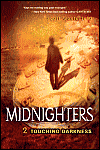
I started Scott Westerfeld's Midnighters series at the end of 2005 and read the other two books in the trilogy this year, Midnighters 2: Touching Darkness (2005) and Midnighters 3: Blue Noon (2006). The first book, Midnighters: The Secret Hour (2004) is mostly introductory, showing us newcomer Jessica as she moves to the small town of Bixby, Oklahoma, only to discover that she's one of five teenagers who can move in the secret midnight hour, when the rest of Bixby is suspended in time. Only there's plenty of nasties also creeping around during the midnight hour.
The trilogy really takes off in the second book, as the five teenagers try to discover what happened to all the other midnighters throughout history, what makes Bixby susceptible to midnighter activity, and where the next attack of creatures is coming from. And who is the strange old woman they keep seeing? The third book was not quite as satisfying as the first two, but overall a nice series.

An asthmatic seventh-grade boy, a new school, an odd-looking key and atlas, a villain in a wheelchair, dog-faced creatures, a labyrinthine house, a mysterious plague... It's all in Garth Nix's The Keys to the Kingdom, Book One: Mister Monday (2003), an exciting, fast-paced read that begins a seven-book series. (The fifth book, Lady Friday, will be released in the U.S. in March, 2007.) Nix does a wonderful job of mixing the familiar (How was the universe born and how can man control it for selfish purposes?) with fresh ideas. The biggest problem with the series? It's not finished yet.

Another storyline we've seen before is first love and The End of the World, but the Jane Yolen/Bruce Coville collaboration Armageddon Summer (1998) refuses to rehash a predictable, routine story. Fourteen-year-old Marina meets sixteen-year-old Jed on a remote mountain that serves as the last settlement of a cult called The Believers. As the end of the world approaches, what matters most? Faith, belief or love? Told in alternating chapters from the viewpoint of both lovers, Armageddon Summer is a thought-provoking YA novel filled with complex characters and no easy answers.
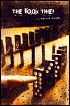
Treading on familiar ground once again, we have The Book Thief (2006) by Marcus Zusak, a book set in Nazi Germany, narrated by Death. You might think "I've seen this before. Do we really need another YA novel about Nazi Germany?" Okay, you've got a valid point. But consider this from an early chapter, in which Death compares watching humans to seeing colors:
"The last time I saw her was red. The sky was like soup, boiling and stirring. In some places, it was burned. There were black crumbs, and pepper, streaked across the redness."
and later:
"There was the smell of a freshly cut coffin. Black dresses. Enormous suitcases under the eyes. Liesel stood like the rest, on the grass. She read to Frau Holtzapfel that same afternoon. The Dream Carrier, her neighbor's favorite."
This is not your father's YA Nazi Germany novel.
Early in the book, Death follows a young girl named Liesel Meminger and her brother as they are being sent to live with foster parents near Munich in World War II. Death claims the boy and many others, but is intrigued by Liesel, who finds in the snow a book on gravedigging. Her new-found passion for books will have lasting (and not always pleasant) impact and consequences on everyone she encounters.
Although Death's chapter and sub-chapter headings can become tiresome, Zusak by and large avoids sticky-sweet sentimentality and emotionally manipulated scenes. I'm not quite ready, as some seem to be, to proclaim The Book Thief a "modern classic" (whatever that means), but there's no denying the book's power and Zusak's storytelling ability.
Other YA books I enjoyed:
Crispin: The Cross of Lead (2002) – Avi
Only You Can Save Mankind (1992, reissue 2004) – Terry Pratchett
Tuck Everlasting (1975) – Natalie Babbitt
The Amulet of Samarkand (2003) – Jonathan Stroud
The Spiderwick Chronicles, Book One: The Field Guide (2003) – Holly Black & Tony DiTerlizzi
Friday, December 08, 2006
The Year in Review Part Two: Non-Fiction
It's my favorite time of year, list time. Here's how my lists work. (My list, my rules.) These books aren't necessarily 2006 releases. Some of the titles appeared in 2006, but I discovered them all for the first time this year.
Each year I say I'm going to read more non-fiction and I suppose this year wasn't too bad: I read 24 non-fiction titles, a bit more than usual for me. Several were genre-related, several were books on Christianity/spirituality, some history, some biography.
Here we go....
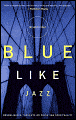
Blue Like Jazz (2003) is a book that's not afraid to say that Christians don't have all the answers and have flat-out screwed things up royally at times. My favorite part of the book occurs when Miller and some of his friends set up a confession booth on their secular college campus. One guy came in to confess and Miller and his friends said, "No, it doesn't work that way. We want to confess to you that as Christians, we've screwed up Christianity, misrepresented Christ, and treated large portions of humanity like crap starting with the Crusades all the way to today. And we're sorry." A great read.
I also discovered two books by Edward T. Welch this year,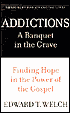
Addictions: A Banquet in the Grave : Finding Hope in the Power of the Gospel (2001) and When People Are Big and God Is Small: Overcoming Peer Pressure, Codependency, and the Fear of Man (1997). Welch writes in a very practical, no-nonsense style that examines not only Scripture, but also psychology, philosophy and much more.

Although I enjoyed Manhunt: The 12-Day Chase for Lincoln's Killer by James L. Swanson (2006), I was enthralled by a book recommended by John,
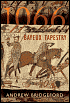
1066: The Hidden History In The Bayeux Tapestry (2005) by Andrew Bridgeford. Manhunt reads like a good thriller, but it also reads like Swanson has done a lot of speculating. Still, a good read, but nothing like 1066. I knew little about the Bayeaux Tapestry and the era going in, but was fascinated by Bridgeford's account. It's certainly more scholarly (but no less entertaining) than the Swanson, with many references to early documents and professional findings. Sure, there's bound to be some speculation involved, but it's mixed with credible theories supported by credible findings.

I tend to gloss over most of the "current events" books, but I was intrigued by The World Is Flat: A Brief History of the Twenty-first Century (2005) by Thomas L. Friedman. I don't know that I agree with everything Friedman says about how our world is changing, becoming flatter, but every aspect of the book was at the least intriguing and often mind-blowing.
I really got into reading horror this year and two of the most useful reference books I ran across were Horror: The 100 Best Books (1988) by Stephen Jones and Kim Newman and the second installment that came out in 2005,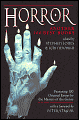
Horror: Another 100 Best Books (2005), also by Jones and Newman. For anyone who wants to discover the horror genre, these two books are invaluable.
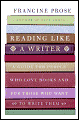
I'm convinced that to become a good writer, you have to be a pretty good reader, something I'm slowly learning to become. Some of Francine Prose's Reading Like a Writer: A Guide for People Who Love Books and for Those Who Want to Write Them (2006) covers fundamental stuff, but it's stuff we all need to know. For someone like me who hasn't had a lot of formal training in writing (or even in reading/understanding/analyzing good writing), this book is a must-read.
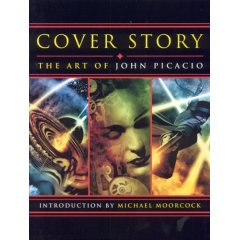
Ever since I saw the cover of Jeffrey Ford's The Fantasy Writer's Assistant, I've been fascinated with the work of John Picacio, one of the most exciting artists in the field. His new collection Cover Story: The Art of John Picacio (2006) is outstanding in every way. Plus Picacio is one of the nicest guys you'll run across anywhere.
 Finally, the best biography I read this year was hands-down James Tiptree, Jr.: The Double Life of Alice B. Sheldon (2006) by Julie Phillips. From hunting trips to Africa as a child, to pulling the wool over the eyes of the entire science fiction community, to writing some of the most powerful genre stories ever written, Alice Sheldon's biography pulls no punches, giving readers a glimpse into the life of an amazing writer.
That's it for non-fiction. Next time: Young Adult
Today's Story = "Monster" – Kelly Link from Best New Fantasy, Sean Wallace, ed.
Each year I say I'm going to read more non-fiction and I suppose this year wasn't too bad: I read 24 non-fiction titles, a bit more than usual for me. Several were genre-related, several were books on Christianity/spirituality, some history, some biography.
Here we go....

Blue Like Jazz (2003) is a book that's not afraid to say that Christians don't have all the answers and have flat-out screwed things up royally at times. My favorite part of the book occurs when Miller and some of his friends set up a confession booth on their secular college campus. One guy came in to confess and Miller and his friends said, "No, it doesn't work that way. We want to confess to you that as Christians, we've screwed up Christianity, misrepresented Christ, and treated large portions of humanity like crap starting with the Crusades all the way to today. And we're sorry." A great read.
I also discovered two books by Edward T. Welch this year,
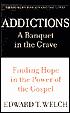
Addictions: A Banquet in the Grave : Finding Hope in the Power of the Gospel (2001) and When People Are Big and God Is Small: Overcoming Peer Pressure, Codependency, and the Fear of Man (1997). Welch writes in a very practical, no-nonsense style that examines not only Scripture, but also psychology, philosophy and much more.

Although I enjoyed Manhunt: The 12-Day Chase for Lincoln's Killer by James L. Swanson (2006), I was enthralled by a book recommended by John,

1066: The Hidden History In The Bayeux Tapestry (2005) by Andrew Bridgeford. Manhunt reads like a good thriller, but it also reads like Swanson has done a lot of speculating. Still, a good read, but nothing like 1066. I knew little about the Bayeaux Tapestry and the era going in, but was fascinated by Bridgeford's account. It's certainly more scholarly (but no less entertaining) than the Swanson, with many references to early documents and professional findings. Sure, there's bound to be some speculation involved, but it's mixed with credible theories supported by credible findings.

I tend to gloss over most of the "current events" books, but I was intrigued by The World Is Flat: A Brief History of the Twenty-first Century (2005) by Thomas L. Friedman. I don't know that I agree with everything Friedman says about how our world is changing, becoming flatter, but every aspect of the book was at the least intriguing and often mind-blowing.
I really got into reading horror this year and two of the most useful reference books I ran across were Horror: The 100 Best Books (1988) by Stephen Jones and Kim Newman and the second installment that came out in 2005,
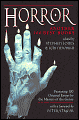
Horror: Another 100 Best Books (2005), also by Jones and Newman. For anyone who wants to discover the horror genre, these two books are invaluable.
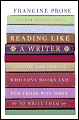
I'm convinced that to become a good writer, you have to be a pretty good reader, something I'm slowly learning to become. Some of Francine Prose's Reading Like a Writer: A Guide for People Who Love Books and for Those Who Want to Write Them (2006) covers fundamental stuff, but it's stuff we all need to know. For someone like me who hasn't had a lot of formal training in writing (or even in reading/understanding/analyzing good writing), this book is a must-read.

Ever since I saw the cover of Jeffrey Ford's The Fantasy Writer's Assistant, I've been fascinated with the work of John Picacio, one of the most exciting artists in the field. His new collection Cover Story: The Art of John Picacio (2006) is outstanding in every way. Plus Picacio is one of the nicest guys you'll run across anywhere.
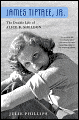 Finally, the best biography I read this year was hands-down James Tiptree, Jr.: The Double Life of Alice B. Sheldon (2006) by Julie Phillips. From hunting trips to Africa as a child, to pulling the wool over the eyes of the entire science fiction community, to writing some of the most powerful genre stories ever written, Alice Sheldon's biography pulls no punches, giving readers a glimpse into the life of an amazing writer.
 That's it for non-fiction. Next time: Young Adult
Today's Story = "Monster" – Kelly Link from Best New Fantasy, Sean Wallace, ed.
Thursday, December 07, 2006
The Year in Review Part One: Sobering Statistics
I've just been looking over my writing for the past year and I'm amazed (and not in a good way). What have I been doing?
I do feel good about finishing one YA novel this year, tentatively titled Fortress. I'm in the process of revising it right now. I've only written one other novel (which no one will ever see), and I am confident that this one is miles better than my first effort.
But I only wrote six new short stories this year. Yeah, six. Most of them took an average of two months to revise. One took six months. And I've got eight other unfinished stories all started this year.
What does all this tell me?
First, I think my writing time is inconsistent. That's not brought out by the numbers, but I can't help but think it's a contributor. Life often gets in the way, but I have to set aside that time and not let anything interfere with it.
Second, I've got to learn to move on to another story if the one I'm working on isn't coming together. I'm just too stubborn, which is why I only have six stories this year.
Counting new and old stories, I've submitted to markets only 23 times this year, a very low number. One story sold. In many cases, several of the stories that got rejected made it well past the first level(s) and one is still being held for consideration by a major market.
Writing resolutions for the new year? In the simplest terms:
Regular hours, no matter what.
Write more.
Send stuff out.
Repeat.
Next: The Year in Review: Non-Fiction
Today's short story: "The Language of Moths" - Christopher Barzak from Best New Fantasy, Sean Wallace, ed.
I do feel good about finishing one YA novel this year, tentatively titled Fortress. I'm in the process of revising it right now. I've only written one other novel (which no one will ever see), and I am confident that this one is miles better than my first effort.
But I only wrote six new short stories this year. Yeah, six. Most of them took an average of two months to revise. One took six months. And I've got eight other unfinished stories all started this year.
What does all this tell me?
First, I think my writing time is inconsistent. That's not brought out by the numbers, but I can't help but think it's a contributor. Life often gets in the way, but I have to set aside that time and not let anything interfere with it.
Second, I've got to learn to move on to another story if the one I'm working on isn't coming together. I'm just too stubborn, which is why I only have six stories this year.
Counting new and old stories, I've submitted to markets only 23 times this year, a very low number. One story sold. In many cases, several of the stories that got rejected made it well past the first level(s) and one is still being held for consideration by a major market.
Writing resolutions for the new year? In the simplest terms:
Regular hours, no matter what.
Write more.
Send stuff out.
Repeat.
Next: The Year in Review: Non-Fiction
Today's short story: "The Language of Moths" - Christopher Barzak from Best New Fantasy, Sean Wallace, ed.
Wednesday, December 06, 2006
Having a Fit
It's been such a busy week, I haven't had time to post. With my car dying a quick death, Cindy and I went to the Honda dealership last Friday to pick out a Civic for her. It certainly wasn't her first choice, but none of the Honda dealerships had the new Fit on the lot for a test drive.
Well, we got to Jim Coleman Honda in Clarksville and saw two Fits staring us in the face. Cindy and I both drove one (black sport model) and loved it. They had just come in the night before and we were literally the first ones to see them. So we bought it. And sold the Saturn. Life is good.
Well, we got to Jim Coleman Honda in Clarksville and saw two Fits staring us in the face. Cindy and I both drove one (black sport model) and loved it. They had just come in the night before and we were literally the first ones to see them. So we bought it. And sold the Saturn. Life is good.
Friday, December 01, 2006
Great Stuff on the Cheap and A Story with No Home
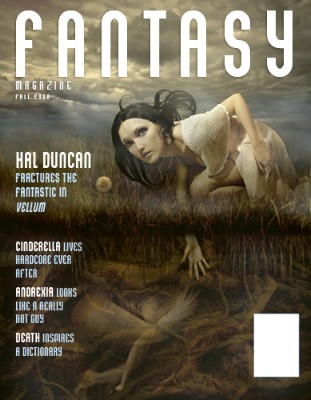
As John pointed out on his blog, Fantasy Magazine (actually Wildside Press) is offering a holiday subscription special: four issues for just ten bucks. Ten bucks! You got ten bucks? No? Skip Starbucks a few times and you've got it. If you haven't read the mag, get it. You won't regret it. (I subscribed yesterday. Thanks for the tip, John!)
***************************
After much revision and a little help from my friends, I finished my story "Graveyard Journal" last night. I'm pleased with the end result, but I wish I had a definite market in mind. It's a horror story with a teenage protagonist, which isn't really that hard to find a home for, but it's nearly 6,000 words, which knocks it out of several horror (like Cemetery Dance) and YA (like Cicada) markets. Yeah, I could probably cut several hundred words, but I've done that before and have never been pleased with the result. I may send it to one of these markets anyway. Maybe there's an upcoming anthology floating around somewhere.
Today's short story: "At the End of the Hall" - Nick Mamatas, Best New Fantasy
Wednesday, November 29, 2006
Wow!

That's right, the Library of America will publish a hardcover edition in June 2007 containing four of Philip K. Dick's novels from the 1960's: The Man in the High Castle, The Three Stigmata of Palmer Eldritch, Do Androids Dream of Electric Sheep? and Ubik.
I'll admit that the only one of these novels in this collection I've read is The Man in the High Castle, but I've read a few others, most recently A Scanner Darkly, which knocked me out. Not only was Dick an important genre writer -- and it's great to see more credibility given to a genre writer -- he was an important writer period. He and his readers certainly deserve this edition.
*********************************
I was at a library sale today and ran across a book I just had to have: Edison & The Electric Chair: A Story of Light and Death by Mark Essig.
I've been fascinated with the concept of the electric chair since I was a kid. I remember hearing some of the old timers hanging around my dad's grocery store, telling tall tales, as old timers will do. One man told about the days when the State of Mississippi had a traveling electric chair, which of course enthralled young ears like mine. When I got older, I dismissed the story as pure bunk.
Years later a friend of mine told me he remembered actually seeing the traveling electric chair as a boy in Quitman, Mississippi. Then I read Andy Duncan's excellent story "The Executioners' Guild" and was once again fascinated. Andy, if you're out there, have you read the Essig book? I imagine any romanticism on the subject is greatly diminished in what I imagine are pretty grisly details, not for the faint of heart.
But I'm still going to read it. Hey, it was only 10 cents.
Monday, November 27, 2006
Today's Survey
Here's the situation: I just took my car in to the shop. Needs a new radiator, around $600, which actually isn't too bad. But the car's ten years old and probably won't last much longer. Here's all the vital information for your consideration:
1997 Saturn SL-1, manual
128,000 miles
Good mileage (between 32-37 mpg)
CD player has an attitude
Repairs completed in the past year:
New water pump/gasket
New ignition coil/switch
Replaced front brake pads and rotors
New windshield
Other routine stuff (including new tires)
Total amount spent (other than normal maintenance) in the past year (not counting the radiator) = $2225.88
Other factors:
We just bought a Toyota Matrix, which we love. It's eventually going to be my car, but Cindy's driving it right now. The next car will be hers, but we can't decide what to get. We want to test-drive a Honda Fit for Cindy, but they don't stay on the lot long enough for you to even look at one. (They don't call it the Fit for nothing. We've had a fit trying to find one.) But we may have to made a decision sooner than we thought.
So whaddya say? Fix the Saturn or sell it?
1997 Saturn SL-1, manual
128,000 miles
Good mileage (between 32-37 mpg)
CD player has an attitude
Repairs completed in the past year:
New water pump/gasket
New ignition coil/switch
Replaced front brake pads and rotors
New windshield
Other routine stuff (including new tires)
Total amount spent (other than normal maintenance) in the past year (not counting the radiator) = $2225.88
Other factors:
We just bought a Toyota Matrix, which we love. It's eventually going to be my car, but Cindy's driving it right now. The next car will be hers, but we can't decide what to get. We want to test-drive a Honda Fit for Cindy, but they don't stay on the lot long enough for you to even look at one. (They don't call it the Fit for nothing. We've had a fit trying to find one.) But we may have to made a decision sooner than we thought.
So whaddya say? Fix the Saturn or sell it?
The Unblemished - Conrad Williams
I'm about halfway through this book, which is a must-read if you're a fan of quality horror fiction (or fiction in general). I plan to write more about it later, but I just have to share this one paragraph. (I hope Mr. Williams doesn't mind.)
After meeting a character in a London bar, Bo experiences some really strange stuff going on in the city. In this scene, Bo's staying at his friend Sammy's house, considering whether or not it's safe to confide in his friend. While Sammy is asleep, Bo hears something from outside the bedroom.
He saw the shape of a hand reach around the edge of the door, its fingers shockingly long. Each of them came to rest against the wood, nails tapping lightly as though it were still incarcerated, knocking politely to be let out. Its smell reached Bo before anything else did: old things left undisturbed for too long: wet rags that had not been allowed to dry properly, desiccated newspapers, woodworm and rust. It shifted like someone whose joints had recently been operated upon, or someone coming back from a traumatic accident, at the start of a physiotherapy programme. Bo resisted the insane drive to offer assistance. He heard a terrible, dry clicking sound and though he didn't want to know what was producing it, found his mind throwing up any number of horrid possibilities. What disturbed him was the knowledge that the truth would be far worse.
This isn't hammer-the-reader-over-the-head horror, but instead an artful balance of terror and desire. Bo is terrified of who (or what) is about to enter the room, yet feels a tinge of compassion, if not responsibility, to somehow help this creature. The sensory details are so vivid you can almost feel the overwhelming odor of the thing wrapping itself around you. And Williams even portrays the painful sickness of Bo's conflict and imagination, "his mind throwing up any number of horrid possibilities."
What happens next is totally unexpected, yet completely satisfying. This guy's an outstanding writer. Check him out.
After meeting a character in a London bar, Bo experiences some really strange stuff going on in the city. In this scene, Bo's staying at his friend Sammy's house, considering whether or not it's safe to confide in his friend. While Sammy is asleep, Bo hears something from outside the bedroom.
He saw the shape of a hand reach around the edge of the door, its fingers shockingly long. Each of them came to rest against the wood, nails tapping lightly as though it were still incarcerated, knocking politely to be let out. Its smell reached Bo before anything else did: old things left undisturbed for too long: wet rags that had not been allowed to dry properly, desiccated newspapers, woodworm and rust. It shifted like someone whose joints had recently been operated upon, or someone coming back from a traumatic accident, at the start of a physiotherapy programme. Bo resisted the insane drive to offer assistance. He heard a terrible, dry clicking sound and though he didn't want to know what was producing it, found his mind throwing up any number of horrid possibilities. What disturbed him was the knowledge that the truth would be far worse.
This isn't hammer-the-reader-over-the-head horror, but instead an artful balance of terror and desire. Bo is terrified of who (or what) is about to enter the room, yet feels a tinge of compassion, if not responsibility, to somehow help this creature. The sensory details are so vivid you can almost feel the overwhelming odor of the thing wrapping itself around you. And Williams even portrays the painful sickness of Bo's conflict and imagination, "his mind throwing up any number of horrid possibilities."
What happens next is totally unexpected, yet completely satisfying. This guy's an outstanding writer. Check him out.
Friday, November 24, 2006
Gym First, Shopping Later
Well, the Eating Season is officially upon us. I survived the surplus of Halloween candy and yesterday's eating festivities (including three pies*), so I'm off to the gym to fight the good fight. Wish me luck. I'll need it - This will be my first visit to the gym since World Fantasy.
But before I subject myself to a morning of pain and ridicule, I want to make my bid for the "Genre-gift-for-the-person-who-doesn't-read-genre" prize. We all have friends and family whom we love in spite of their indifference/disinterest/outright condemnation of genre. With some of these people, we've probably given up, but with others, we continue to hold out a bit of hope.
Even though I haven't quite finished it, my choice for the genre holiday gift for the non-genre reader is Best New Fantasy, edited by Sean Wallace from Prime Books. Here's why:
1. Size - This collection contains 16 stories at 237 pages. Sure, most genre readers have no problem tackling the mammoth 500-page anthologies with twice as many stories, but for those new to the field, this is the perfect size.
2. Price - At $12.95, you can afford to buy one for yourself and one (or two) for a friend. Or a potential friend. Or Uncle Stinky who thinks you're a freak anyway.
3. A little bit of everything. You've got fairy tales, historical stories, horror tales, slipstream, action, beautiful prose, weirdness, you name it. There's truly something for everyone here. Even Uncle Stinky.
There's my pitch.
* No, I didn't eat them all. Not quite.
Wednesday, November 15, 2006
My Hair Length is Determined by the NFL
The barber I go to is really incredible. He takes his time and does a great job, even trimming my moustache, goatee and eyebrows. This guy's really top notch.
But he's also a Pittsburgh Steelers fan.
I've got no problem with that, as long as I get a haircut after a Steelers win. If I go after a loss, the guy's so steamed that I come out of the barber shop looking like the top of my head's been in a battlezone. But the Steelers won on Sunday, so I should be safe.
Go Steelers!
But he's also a Pittsburgh Steelers fan.
I've got no problem with that, as long as I get a haircut after a Steelers win. If I go after a loss, the guy's so steamed that I come out of the barber shop looking like the top of my head's been in a battlezone. But the Steelers won on Sunday, so I should be safe.
Go Steelers!
Subscribe to:
Posts (Atom)