For the past several months, I've been reading bits and pieces of Word Work by Bruce Holland Rogers. Bruce says that lots of writers are good at goal-setting, but not so good at goal-tracking.
Just writing down wishes and ideas is good, but you need more, a sense of direction. Says Rogers:
The next stage is to translate these wishes into concrete accomplishments with the question: What things can I do within the next six months that will move...in the direction of these wishes? Here, the outcomes we can't control are viewed from the perspective of what we can control. I can't require the contest judges to hand me a prize, but I can write a story that will be eligible for the contest and send it in by the entry deadline.
Setting goals with a partner can help you move from Point A to Point B. Start with long-term wishes and move to six-month goals. Eventually you break long-term goals down to weekly goals. (This is a very simplified version of what Rogers suggests.) Your partner is in effect your accountability partner, which is a good idea. It doesn't have to be another writer. It can be your spouse, a friend, anybody (maybe even somebody that reads your blog!) that helps you keep track of your goals.
Although today I was accountable to myself for writing 500 words, which I did. I hope to do so again tomorrow. Hold me to it.
Tuesday, July 10, 2007

Monday, July 09, 2007
Facebook Weekend and The Writing Thing
A good weekend all in all, with Cindy and I seeing Michael Moore's Sicko, hanging out with my good friend John and his wife Lera, and spending a lot of time on Facebook.
If you haven't been to Facebook, check it out. From what I've heard, it was originally designed as a network for the college crowd. Then Facebook decided to let in high school kids, and now the floodgates are opened wide enough to let in old coots like me.
Anyway, I've connected with several former students, other writers, friends from long ago and far away. You can do all sorts of things on Facebook, even poke people. (They might even poke you back.)
**********************************
Writing was pretty frustrating for awhile, but it's getting better. I think one of the reasons is that I've been studying stories more. After I've studied a good story, I get the feeling that, "Okay, I'm not that good yet, but now I understand why the writer did this or that here or there." Small steps. Small patient steps.
If you haven't been to Facebook, check it out. From what I've heard, it was originally designed as a network for the college crowd. Then Facebook decided to let in high school kids, and now the floodgates are opened wide enough to let in old coots like me.
Anyway, I've connected with several former students, other writers, friends from long ago and far away. You can do all sorts of things on Facebook, even poke people. (They might even poke you back.)
**********************************
Writing was pretty frustrating for awhile, but it's getting better. I think one of the reasons is that I've been studying stories more. After I've studied a good story, I get the feeling that, "Okay, I'm not that good yet, but now I understand why the writer did this or that here or there." Small steps. Small patient steps.
Saturday, July 07, 2007
"Three Popes Walk into a Bar" - Amy Hempel (a few spoilers)
The unnamed female narrator meets her friend Wesley, a stand-up comic, in a park before one of his performances. Wesley is in a relationship with a self-centered former topless dancer named Eve, and to put it mildly, Wesley and Eve are not on the same page. He's not sure whether he should continue to perform or just leave it all (which is Eve's hope), buy a boat and live it up.
Wesley tells the narrator that a man once gave him an opening line and bet him he couldn't build a joke around it and come up with a punchline. Wesley took the bet and the man said, "Three popes walk into a bar." Wesley lost the bet.
The whole story (and many of the Helpel stories I've read so far) deals with relationships, lies, doubt, deception and self-deception, powerlessness, and how we attempt to heal the parts of our lives that are obviously wrong or even altogether fake. The story begins and ends in a park that's so artificial it doesn't even have benches. The owner of the nightclub introduces Wesley by saying, "Every night I come out here and tell you what a great show we have and you know, it's the God's honest truth. But tonight I really mean it."
In my favorite scene in the story, Wesley shows the narrator an old video of himself doing a television commercial for a product that seals concrete, or to put it another way, a product that heals brokenness. It's ironic that in Wesley's strained relationship with Eve, this is her favorite commercial. Even more ironic is the fact that Wesley's former partner (who also appears in the commercial) splits their relationship in order to run for mayor, using the platform "Anything You Want."
At some point, Wesley has to make a decision: Do what he wants and stick with stand-up comedy or do what Eve wants and leave it in order to meets her needs and whims. When he tells the narrator his decision, she pretty much agrees with him, but even this is a deception. For her, it's like trying to find a punchline for the man's opening line "Three popes walk into a bar." She doesn't have an answer.
There's so much to like about Hempel's writing. It's deceptively easy to read, yet full of treasure. Hempel leaves a lot of ambiguity in many of her stories, which probably makes readers who love nice clean, neat, wrapped-up stories climb the walls, but I love it. The stories are lean; every word counts. And I can't speak for other readers, but after I've read one of her stories, I can't stop thinking about it.
I could probably zip through The Collected Stories in a couple of weeks, but why would I want to? There's just too much here to savor. This is a book I'll definitely want to own, but in the meantime, the library's going to have a tough time getting their copy back.
Wesley tells the narrator that a man once gave him an opening line and bet him he couldn't build a joke around it and come up with a punchline. Wesley took the bet and the man said, "Three popes walk into a bar." Wesley lost the bet.
The whole story (and many of the Helpel stories I've read so far) deals with relationships, lies, doubt, deception and self-deception, powerlessness, and how we attempt to heal the parts of our lives that are obviously wrong or even altogether fake. The story begins and ends in a park that's so artificial it doesn't even have benches. The owner of the nightclub introduces Wesley by saying, "Every night I come out here and tell you what a great show we have and you know, it's the God's honest truth. But tonight I really mean it."
In my favorite scene in the story, Wesley shows the narrator an old video of himself doing a television commercial for a product that seals concrete, or to put it another way, a product that heals brokenness. It's ironic that in Wesley's strained relationship with Eve, this is her favorite commercial. Even more ironic is the fact that Wesley's former partner (who also appears in the commercial) splits their relationship in order to run for mayor, using the platform "Anything You Want."
At some point, Wesley has to make a decision: Do what he wants and stick with stand-up comedy or do what Eve wants and leave it in order to meets her needs and whims. When he tells the narrator his decision, she pretty much agrees with him, but even this is a deception. For her, it's like trying to find a punchline for the man's opening line "Three popes walk into a bar." She doesn't have an answer.
There's so much to like about Hempel's writing. It's deceptively easy to read, yet full of treasure. Hempel leaves a lot of ambiguity in many of her stories, which probably makes readers who love nice clean, neat, wrapped-up stories climb the walls, but I love it. The stories are lean; every word counts. And I can't speak for other readers, but after I've read one of her stories, I can't stop thinking about it.
I could probably zip through The Collected Stories in a couple of weeks, but why would I want to? There's just too much here to savor. This is a book I'll definitely want to own, but in the meantime, the library's going to have a tough time getting their copy back.
Friday, July 06, 2007
Reading Amy Hempel

A few years ago a friend of mine asked me to look for a copy of a book called At the Gates of the Animal Kingdom by Amy Hempel. At the time, a hardcover first edition was selling on Amazon for about $50. It's still hanging around at that price. I kept my eyes peeled while on my book rounds, but no kingdom of animals turned up, other than a wild book or two by Marlin Perkins. (If you get that joke, you must be over 40.)
Anyway, I saw The Collected Stories of Amy Hempel at the library and checked it out. I'm really enjoying it. Hempel has been labeled a "minimalist" but I don't know how accurate that (or any) label really is. I just know I'm enjoying her stories and plan to blog about one of them in detail tomorrow.
I started looking for non-Internet info. on Hempel and was surprised that she appeared neither in my 1998 copy of The Reading List: Contemporary Fiction: A Critical Guide to the Complete Works of 110 Authors* or in The Salon.com Reader's Guide to Contemporary Authors (2000), although she had three collections in print before these books came out. What's up with that?
Ah, but she does appear in The Columbia Companion to the Twentieth-Century American Short Story (2001), so at least Amy's getting some lovin' somewhere.
Anyway, more about one of her stories tomorrow. In the meantime, check her out. The new collection covers her previous four short story collections, which I believe is her entire output thus far. If the book isn't in your local library or if you don't want to shell out the $$ for a hardcover, the paperback edition will be released on September 18.
* Which has now been expanded to 125 authors, but still doesn't include Hempel.
********************************
500 words on a new story. (One of mine, not one of Amy's.) Always a good way to start the weekend.
Tuesday, July 03, 2007
June Books Read
Here we go....
Through Painted Deserts: Light, God, and Beauty on the Open Road (NF 2000/2005) – Donald Miller
Not as enjoyable or as thought-provoking as some of Miller's other books, but still a good read.
The Book of Three (YA 1964) – Lloyd Alexander
I read this book several years ago and (as mentioned yesterday) since Alexander's recent death, I decided to read the whole series. The book has held up for 40+ years for a reason.
The Black Echo (1992) – Michael Connelly
Connelly's first Harry Bosch novel and first novel period. Nobody is better at procedure than Connelly. Excellent for a first novel.
Countdown: The Race for Beautiful Solutions at the International Mathematical Olympiad (NF 2004) – Steve Olson
You don't have to be a math whiz (I'm certainly not.) to enjoy this look at several contestants from the International Mathematical Olympiad. It's much more than "Hoosiers with Calculus." Olson examines how we learn, the question of talent vs. hard work, and much more. A fun read.
For Whom the Bell Tolls (1940) – Ernest Hemingway
It's Hemingway. What else do you need?
Over Sea, Under Stone (YA 1965) – Susan Cooper
Like the Alexander books, the first in a five-part series collectively called The Dark is Rising sequence. When you've run out of Harry Potter, read Alexander and Cooper.
Softspoken (2007) – Lucius Shepard
About halfway into this one, I was mildly disappointed, but by the time I got to the end and spent some time thinking about it, the more I realized that Shepard's hit it out of the park once again. Chilling in a very unexpected way.
The No Asshole Rule: Building a Civilized Workplace and Surviving One That Isn't (NF 2007) - Robert I. Sutton
I saw this on audio at the library and couldn't resist. The subtitle, "Building a Civilized Workplace" wasn't on the audiobook cover, so I was a bit disappointed that Sutton focused only on the workplace. Still, that's the fault of Recorded Books and not Sutton. It seemed like most of the book was geared more to employers and management than employees, but still a good read/listen.
That's it for this month. Go read.
Through Painted Deserts: Light, God, and Beauty on the Open Road (NF 2000/2005) – Donald Miller
Not as enjoyable or as thought-provoking as some of Miller's other books, but still a good read.
The Book of Three (YA 1964) – Lloyd Alexander
I read this book several years ago and (as mentioned yesterday) since Alexander's recent death, I decided to read the whole series. The book has held up for 40+ years for a reason.
The Black Echo (1992) – Michael Connelly
Connelly's first Harry Bosch novel and first novel period. Nobody is better at procedure than Connelly. Excellent for a first novel.
Countdown: The Race for Beautiful Solutions at the International Mathematical Olympiad (NF 2004) – Steve Olson
You don't have to be a math whiz (I'm certainly not.) to enjoy this look at several contestants from the International Mathematical Olympiad. It's much more than "Hoosiers with Calculus." Olson examines how we learn, the question of talent vs. hard work, and much more. A fun read.
For Whom the Bell Tolls (1940) – Ernest Hemingway
It's Hemingway. What else do you need?
Over Sea, Under Stone (YA 1965) – Susan Cooper
Like the Alexander books, the first in a five-part series collectively called The Dark is Rising sequence. When you've run out of Harry Potter, read Alexander and Cooper.
Softspoken (2007) – Lucius Shepard
About halfway into this one, I was mildly disappointed, but by the time I got to the end and spent some time thinking about it, the more I realized that Shepard's hit it out of the park once again. Chilling in a very unexpected way.
The No Asshole Rule: Building a Civilized Workplace and Surviving One That Isn't (NF 2007) - Robert I. Sutton
I saw this on audio at the library and couldn't resist. The subtitle, "Building a Civilized Workplace" wasn't on the audiobook cover, so I was a bit disappointed that Sutton focused only on the workplace. Still, that's the fault of Recorded Books and not Sutton. It seemed like most of the book was geared more to employers and management than employees, but still a good read/listen.
That's it for this month. Go read.
Monday, July 02, 2007
June Books Bought
Just the books bought today; the read ones tomorrow. Deal?
Okay, I bought quite a few in June, most of which I found at a sale I stumbled upon completely by accident. (I love those kinds of accidents.) All were purchased on the cheap. (I think the most I paid for any book was $2.)
BOOKS BOUGHT
Six Easy Pieces : Essentials of Physics, Explained by its Most Brilliant Teacher (NF 1996) - Richard P. Feynman
Hey, Dr. Phil will be proud! I heard about this book several years ago (maybe even from you, Dr. Phil), that it was a good book for the layman.
And Die in the West: The Story of the O.K. Corral Gunfight (NF 1989) - Paula Mitchell Marks
C'mon, who can resist a book about the gunfight at the O.K. Corral? Not me.
The Facts on File Visual Dictionary (NF 1986) - Jean-Claude Corbeil
Looks like a good writer's reference to me.
The Godwulf Manuscript (1974) - Robert B. Parker
The first Spencer novel, which I read years ago but wanted to read again. A few months ago I listened to a more current Spencer novel, School Days, and thought I'd (eventually) journey through all the Spencer novels.
The Black Cauldron (YA 1965) - Lloyd Alexander
Beloved children's writer Alexander recently passed away and I wanted to read the entire Prydain Chronicles. This was the only book I didn't have.
Pop. 1280 (1964) - Jim Thompson
Okay, this was a blockhead purchase, since I've still got Thompson's The Killer Inside Me unread and don't even know if I'll like it. But, I rarely run across Thompson's books, which are highly praised, so I bought it. (Hey, it was only 50 cents...)
Light (2004) - M. John Harrison
I've been told by many that this one's a winner, so I picked it up on the cheap. The only other Harrison I've read is an early novel The Centauri Device (which I couldn't finish) and a short story called "Tourists" which I really enjoyed.
With Good Reason: An Introduction to Informal Fallacies (NF 1982) - S. Morris Engel
I heard a few discussions on this topic several years ago, which sparked my renewed interest in learning some of the basics of logic. We'll see if my illogical mind can grasp some of the concepts.
The Concrete Blonde (1994) - Michael Connelly
I'm in the process of collecting all of Connelly's Harry Bosch novels in hardcover first editions, which this one is.
NEXT TIME: Books Read
Okay, I bought quite a few in June, most of which I found at a sale I stumbled upon completely by accident. (I love those kinds of accidents.) All were purchased on the cheap. (I think the most I paid for any book was $2.)
BOOKS BOUGHT
Six Easy Pieces : Essentials of Physics, Explained by its Most Brilliant Teacher (NF 1996) - Richard P. Feynman
Hey, Dr. Phil will be proud! I heard about this book several years ago (maybe even from you, Dr. Phil), that it was a good book for the layman.
And Die in the West: The Story of the O.K. Corral Gunfight (NF 1989) - Paula Mitchell Marks
C'mon, who can resist a book about the gunfight at the O.K. Corral? Not me.
The Facts on File Visual Dictionary (NF 1986) - Jean-Claude Corbeil
Looks like a good writer's reference to me.
The Godwulf Manuscript (1974) - Robert B. Parker
The first Spencer novel, which I read years ago but wanted to read again. A few months ago I listened to a more current Spencer novel, School Days, and thought I'd (eventually) journey through all the Spencer novels.
The Black Cauldron (YA 1965) - Lloyd Alexander
Beloved children's writer Alexander recently passed away and I wanted to read the entire Prydain Chronicles. This was the only book I didn't have.
Pop. 1280 (1964) - Jim Thompson
Okay, this was a blockhead purchase, since I've still got Thompson's The Killer Inside Me unread and don't even know if I'll like it. But, I rarely run across Thompson's books, which are highly praised, so I bought it. (Hey, it was only 50 cents...)
Light (2004) - M. John Harrison
I've been told by many that this one's a winner, so I picked it up on the cheap. The only other Harrison I've read is an early novel The Centauri Device (which I couldn't finish) and a short story called "Tourists" which I really enjoyed.
With Good Reason: An Introduction to Informal Fallacies (NF 1982) - S. Morris Engel
I heard a few discussions on this topic several years ago, which sparked my renewed interest in learning some of the basics of logic. We'll see if my illogical mind can grasp some of the concepts.
The Concrete Blonde (1994) - Michael Connelly
I'm in the process of collecting all of Connelly's Harry Bosch novels in hardcover first editions, which this one is.
NEXT TIME: Books Read
Thursday, June 28, 2007
Enter at Your Own Risk
It's very tempting sometimes to try to rush a story for one reason or another. Case in point: I'm currently working on a story that I think would probably fit the guidelines for the Chizine short story contest, but with two days left, I just don't think it's going to happen. It would be far too easy to try to force the story or manipulate it into something that it's not, just for the sake of entering the contest. I think this story has the potential to be pretty good, but there's still a lot to be worked out and it needs to be more organic. I feel like I'm forcing, so that's probably an indication that it won't turn out as well as I'd like. Besides, it's just a contest. There's one on just about every corner. Or maybe that's a Starbucks I'm thinking of...
********************************
Today's top book find: a signed first edition hardcover copy of Bernard Cornwell's Enemy of God. Not bad at all.
********************************
Today's top book find: a signed first edition hardcover copy of Bernard Cornwell's Enemy of God. Not bad at all.
Wednesday, June 27, 2007
The Unforgiving Middle
No, not my unforgiving middle, although after a few days of Cindy's birthday cake, my middle is also quite unforgiving. It's the middle of my current story that's unforgiving. I'm very pleased with the story's opening (slightly over 1000 words) and have a pretty good idea of how the story will end, but the middle could go in several different directions. Could be that I'm afraid the middle might lead me to a different ending, which might not be a bad thing. We shall see.
Tuesday, June 26, 2007
Playing Favorites, Installment # 6

Installment #6 - "Dallas" (Jimmie Dale Gilmore) - The Flatlanders (1972/1992)
Did you ever see Dallas from a DC-9 at night?
Well Dallas is a jewel, oh yeah, Dallas is a beautiful sight.
And Dallas is a jungle but Dallas gives a beautiful light.
Did you ever see Dallas from a DC-9 at night?
Well, Dallas is a woman who will walk on you when you're down.
But when you are up, she's the kind you want to take around.
But Dallas ain't a woman to help you get your feet on the ground.
Yes Dallas is a woman who will walk on you when you're down.
Clearly Jimmie Dale Gilmore has a wonderful love/hate relationship with the city. If the lyrics leave any doubt, listen to the song. It starts as a sort of upbeat alternate country (before there was such a thing) song, but the more you hear, the sadder – heck, almost tragic – the song gets. Then the saw starts. No, not a chainsaw, but an actual warbling saw, giving the song an otherworldly (if not underworldly) feel. By the time we get to the song's bridge, you really feel for the poor schmuck singing it:
Well, I came into Dallas with the bright lights on my mind
But I came into Dallas with a Dollar and a dime.
And the third verse leaves no doubt – Dallas is one cold, heartless dude:
Dallas is a rich man with a death wish in his eye
A steel and concrete soul with a warm hearted love disguise
A rich man who tends to believe in his own lies
Dallas is a rich man with a death wish in his eyes
Says writer Gilmore: "The hook line of the song occurred to me while I was actually flying into Dallas. The line just presented itself to me. I had all those mixed feelings about the city and the song just came gradually. I've never felt that I've got it down right, though. I've always been a perfectionist about that song.... I've had a strange relationship with the song. I've had periods when I wish I'd never written it, then I've rediscovered it, looking at it through different eyes."
The song (and several others) was recorded in 1972 for an album, but the record company released a promotional single of "Dallas" first. It did nothing. The album was abandoned and available only in the 8-track tape format until Rounder Records bought the rights and released it on CD in 1992, creating an immediate fan base and a huge problem: The 1992 release was warmly embraced by the alt. country crowd, yet they forgot that the music they were hearing was already twenty years old. The Flatlanders, while still around, have stylistically moved on.
They've released other discs, none of which have matched the popularity of the album which "Dallas" opens, appropriately titled More a Legend Than a Band.
Thursday, June 21, 2007
Contest News
I just found out that my YA novel Fortress came in second place in the Science Fiction/Fantasy/Speculative category in the Maryland Writers' Association 2007 Novel Contest. (Scroll down - SF/F/S is at the bottom.)
Second prize carries no money, alas, but that's okay. The contest normally has several entries, a number of them from out-of-state, so I'm very pleased. I'll get critiques back from the judges that hopefully will help me polish the novel before trying to sell it.
Whoot!
Second prize carries no money, alas, but that's okay. The contest normally has several entries, a number of them from out-of-state, so I'm very pleased. I'll get critiques back from the judges that hopefully will help me polish the novel before trying to sell it.
Whoot!
AFI's Top 100

Here's AFI's latest list of the 100 greatest American films of all time. Sorry, I just can't give full credit to any list that includes Titanic (sorry, Dr. Phil) and Butch Cassidy and the Sundance Kid. But with most of the other choices, I can't complain.
So what films aren't in there that you'd include? Off the top of my head, I'd put in
My Darling Clementine (1946)
A Face in the Crowd (1957)
The Conversation (1974)
Let your voice be heard!
**************************
Good progress this morning on a new story. It's nice when things start to come together. It's not so nice when you hear the trash truck coming down the street and realize you've completely lost track of time.
Tuesday, June 19, 2007
Writing, Talent and Mozart
I was somewhat stunned yesterday when I opened my "Stories Sent" spreadsheet and saw that I have only two stories (and one novel) in the pipeline. Could be that I'm taking more time with stories, more than I used to, which for me is a good thing. In the past I've been too quick to send something out before it was in sendable shape. Some people might think it's a good idea to send out stories that aren't quite polished, thinking that they'll get some good comments on how to tighten them up.
For my money, it doesn't work that way. First of all, it's not the editor's job to critique your story for you. Second, they don't have time for it. Unless you're working on a story for a specific contest, what's the hurry? I've been teaching myself to take it slow, to make sure I really know the characters/setting/tone/etc. before putting stamps on envelopes (or hitting the "send" button).
But I still write stuff, either freewrites or exercises that will probably never develop into publishable ideas or see the light of day. But that writing is still important.
On a somewhat related note, I read something interesting in Steve Olson's Count Down: The Race for Beautiful Solutions at the International Mathematical Olympiad. Olson cites several studies comparing talent vs. hard work. University of Exeter psychologist Michael Howe (author of Genius Explained) argues against "the idea that just a few people are born with a special mental capacity that enables them to achieve high levels of performance in a particular field." Hard work and persistence are what matter, says Howe.
Howe notes that even with the advantages of growing up in a musical household, Mozart had to work and work hard. He gives Mozart's practice time a very conservative estimate of three hours a day. From age three (when he supposedly began to play) to age six (his first musical tour of Europe), Mozart would have had 3,500 hours of practice. "That's about how long it takes for a young performer to become a very good amateur," says Howe.
Howe goes on to state (This is paraphrased, mind you.) that to achieve a recognizable level of mastery in any field requires roughly ten years of methodical, disciplined practice. After all, Mozart's first concerto that was recognized as a masterpiece is his Piano Concerto No. 9 in Eb Major (K. 271), written when he was 21, well more than a decade after he started composing.
If that's true, that it takes a good ten years of work before you produce anything good, then I've got about a three-year grace period. I don't know if I'd put all my eggs in Howe's basket --- I tend to agree more with Ray Bradbury's assessment that it takes writing a million words (which hopefully would come to pass before ten years would) before you produce anything good. Whatever the case, I know that I'm gradually getting better at this writing thing and that it takes time; you can't rush it.
So...what's the word count for today?
For my money, it doesn't work that way. First of all, it's not the editor's job to critique your story for you. Second, they don't have time for it. Unless you're working on a story for a specific contest, what's the hurry? I've been teaching myself to take it slow, to make sure I really know the characters/setting/tone/etc. before putting stamps on envelopes (or hitting the "send" button).
But I still write stuff, either freewrites or exercises that will probably never develop into publishable ideas or see the light of day. But that writing is still important.
On a somewhat related note, I read something interesting in Steve Olson's Count Down: The Race for Beautiful Solutions at the International Mathematical Olympiad. Olson cites several studies comparing talent vs. hard work. University of Exeter psychologist Michael Howe (author of Genius Explained) argues against "the idea that just a few people are born with a special mental capacity that enables them to achieve high levels of performance in a particular field." Hard work and persistence are what matter, says Howe.
Howe notes that even with the advantages of growing up in a musical household, Mozart had to work and work hard. He gives Mozart's practice time a very conservative estimate of three hours a day. From age three (when he supposedly began to play) to age six (his first musical tour of Europe), Mozart would have had 3,500 hours of practice. "That's about how long it takes for a young performer to become a very good amateur," says Howe.
Howe goes on to state (This is paraphrased, mind you.) that to achieve a recognizable level of mastery in any field requires roughly ten years of methodical, disciplined practice. After all, Mozart's first concerto that was recognized as a masterpiece is his Piano Concerto No. 9 in Eb Major (K. 271), written when he was 21, well more than a decade after he started composing.
If that's true, that it takes a good ten years of work before you produce anything good, then I've got about a three-year grace period. I don't know if I'd put all my eggs in Howe's basket --- I tend to agree more with Ray Bradbury's assessment that it takes writing a million words (which hopefully would come to pass before ten years would) before you produce anything good. Whatever the case, I know that I'm gradually getting better at this writing thing and that it takes time; you can't rush it.
So...what's the word count for today?
Monday, June 18, 2007
Post-Vacation Post

Back from a true family vacation consisting of Cindy and me, Cindy's two sisters and their families and Cindy's parents all staying in a rental house on Cape Cod, Mass. In addition to Cape Cod, Cindy and I hit a few other places including a bit of Boston (Pizzaria Regina is well worth your time.) and Plymouth (Plymouth Rock isn't.)
One of the major highlights for me was at the Chatham Seaside Links, where I played nine holes of golf. It was the first time I'd played golf since 1980. I've always given my brother-in-law Dave a hard time about golf, saying that it isn't a sport, it's a game of skill and you don't have to be an athlete to play, and other such derogatory statements. But he asked if I wanted to try it and even brought along extra clubs for me, so how could I say no?
I must admit, golf is highly addictive. And I did okay, at least that's what Dave told me. I still contend that golf is more a game of skill than an athletic activity (I'd put it at 60% skill/40% athletic ability.), but it does require more athletic ability than I'd originally thought. Who knows? Maybe I'll pick up a set of clubs soon and see what happens.
Food? Yes, food. Lots of it. Ridiculous amounts of it.

Here's a breakfast of cinammon swirl pancakes with strawberries that I had one morning. When I ordered I figured there would be maybe four strawberries. Wrong.
We also had lobster rolls, tons of other seafood, desserts, you name it. Man. My stomach hurts just thinking about it.
A few other shots for your viewing pleasure. More on writing next time.


Friday, June 08, 2007
Wednesday, June 06, 2007
May Books Bought and Read
Okay, so I didn't get as many books read in May as I did in April, but I didn't buy as many either, which is a good thing. All of the books bought were purchased "on the cheap" (half-price or better) which is also a good thing.
Just for fun, I thought I'd give my justification for each purchase plus a little about each book I read. As always, recommended books are linked.
BOOKS BOUGHT
The King in the Window (YA 2006) - Adam Gopnik
This purchase was based solely on Elizabeth Hand's review in F&SF a few months back. In most cases, her recommendation is good enough for me. For more on Hand, keep reading.
Last Summer at Mars Hill (collection, 1998) - Elizabeth Hand
Well, here she is! I enjoyed Hand's latest collection Saffron and Brimstone so much that I strongly suspected I'd like this older one. I stood inside Wonder Books in Hagerstown, MD reading the first two paragraphs of the title story and knew it was worth the $5.95 they were asking.
Some of Your Blood (1977) - Theodore Sturgeon
I'd read good things about this one when Millepede Press came out with a new edition last year. Unfortunately this is an old mass market paperback without the Steve Rasnic Tem introduction, but I was still glad to find it. Plus my friend Kelly told me this one's a winner.
The Faces of Fantasy (NF/photography, 1996) - Patti Perret
Apparently a companion volume to The Faces of Science Fiction, The Faces of Fantasy includes photo portraits and short thoughts from several important writers in fantasy. Interesting to see how some of these people looked 10 years ago. Some haven't changed much. Some have.
The People of Paper (2005) - Salvador Plascencia
Matthew Cheney had some very nice things to say about this one on his blog. That's good enough for me.
The Millennium Problems : The Seven Greatest Unsolved Mathematical Puzzles of Our Time (NF 2002) - Kevin Devlin
Anyone who knows me well is rolling around on the floor laughing hysterically at this point. Like I'm gonna solve one of these.... But I've been reading a few "Math and Science for Morons" books lately and I thought I might enjoy this one.
BOOKS READ
Lisey's Story (2006) - Stephen King
Many people panned King's latest novel, but I think it's very good. In fact, I'd go so far as to put it firmly in King's Top Ten. It's a superb mix of fantasy and reality, something King has always done pretty well, but the emotional impact of Lisey's Story just never lets up. I don't think I've cared this much about a King character since Johnny Valentine Smith in The Dead Zone. You'll read reviews saying that this one's too slow, too touchy-feely, King getting in touch with his feminine side... For what it's worth, I saw it as a lovely tribute to his wife Tabitha.
The Speed of Dark (2002) - Elizabeth Moon
Although there's a good bit of science in this novel, Moon (the mother of an autistic son) focuses mainly on what it's like to be an autistic person trying to make sense of the world. Very moving, very well-written.
What the Dead Know (2007) - Laura Lippman
When I travel outside the Baltimore/Washington area, I'm always stunned at how many people don't know about Laura Lippman, one of today's best mystery writers. What the Dead Know is a stand-alone book (not part of Lippman's Tess Monaghan series) and one of her best.
How to Think Like a Millionaire (NF 1997) – Mark Fisher with Marc Allen
I literally read this while brushing my teeth. (Not all at once; that would be a record.) Really. It's very short. In spite of the title, the book has very little to do with money and more about goal-setting, visualizing success, that sort of thing. Not a bad read. My teeth enjoyed it.
Mississippi Sissy (memoir, 2007) - Kevin Sessums
Kevin Sessums and I both grew up in Forest, Mississippi, but he was a few years older than me, so I didn't really know him very well. This is an outstanding memoir of loss (Kevin and his two siblings lost their parents at an early age) and growing up gay in the Deep South. A bit graphic sexually, but an extremely moving memoir by an outstanding writer.
Velvet Elvis: Repainting the Christian Faith (NF 2005) - Rob Bell
What does it mean to be a Christian? Bell has some interesting and somewhat controversial things to say on the subject. A good book to read after you've read Donald Miller's Blue Like Jazz.
You Don't Love Me Yet (2007) - Jonathan Lethem
A bit of a disappointment. Some good moments, some very funny stuff, but not his strongest. I don't know, maybe he wanted to do something different; he's entitled to that. Motherless Brooklyn and Gun with Occasional Music are two of my all-time favorites - maybe I just set the Lethem bar a little too high.
The Green Glass Sea (YA 2006) - Ellen Klages
An absolutely beautiful book; I loved every page of it. It's the story of two girls living in Los Alamos during WWII. Their parents are scientists who can't talk about their work when they come home, which isn't often. All the girls know is that they're helping to build some type of "gadget." While the adults are building to destroy, Dewey and Suze are building something more important and permanent: friendship. Everything about this book works and it works without being sappy or sentimental. A must-read.
Not a bad month. More next time.
Just for fun, I thought I'd give my justification for each purchase plus a little about each book I read. As always, recommended books are linked.
BOOKS BOUGHT
The King in the Window (YA 2006) - Adam Gopnik
This purchase was based solely on Elizabeth Hand's review in F&SF a few months back. In most cases, her recommendation is good enough for me. For more on Hand, keep reading.
Last Summer at Mars Hill (collection, 1998) - Elizabeth Hand
Well, here she is! I enjoyed Hand's latest collection Saffron and Brimstone so much that I strongly suspected I'd like this older one. I stood inside Wonder Books in Hagerstown, MD reading the first two paragraphs of the title story and knew it was worth the $5.95 they were asking.
Some of Your Blood (1977) - Theodore Sturgeon
I'd read good things about this one when Millepede Press came out with a new edition last year. Unfortunately this is an old mass market paperback without the Steve Rasnic Tem introduction, but I was still glad to find it. Plus my friend Kelly told me this one's a winner.
The Faces of Fantasy (NF/photography, 1996) - Patti Perret
Apparently a companion volume to The Faces of Science Fiction, The Faces of Fantasy includes photo portraits and short thoughts from several important writers in fantasy. Interesting to see how some of these people looked 10 years ago. Some haven't changed much. Some have.
The People of Paper (2005) - Salvador Plascencia
Matthew Cheney had some very nice things to say about this one on his blog. That's good enough for me.
The Millennium Problems : The Seven Greatest Unsolved Mathematical Puzzles of Our Time (NF 2002) - Kevin Devlin
Anyone who knows me well is rolling around on the floor laughing hysterically at this point. Like I'm gonna solve one of these.... But I've been reading a few "Math and Science for Morons" books lately and I thought I might enjoy this one.
BOOKS READ
Lisey's Story (2006) - Stephen King
Many people panned King's latest novel, but I think it's very good. In fact, I'd go so far as to put it firmly in King's Top Ten. It's a superb mix of fantasy and reality, something King has always done pretty well, but the emotional impact of Lisey's Story just never lets up. I don't think I've cared this much about a King character since Johnny Valentine Smith in The Dead Zone. You'll read reviews saying that this one's too slow, too touchy-feely, King getting in touch with his feminine side... For what it's worth, I saw it as a lovely tribute to his wife Tabitha.
The Speed of Dark (2002) - Elizabeth Moon
Although there's a good bit of science in this novel, Moon (the mother of an autistic son) focuses mainly on what it's like to be an autistic person trying to make sense of the world. Very moving, very well-written.
What the Dead Know (2007) - Laura Lippman
When I travel outside the Baltimore/Washington area, I'm always stunned at how many people don't know about Laura Lippman, one of today's best mystery writers. What the Dead Know is a stand-alone book (not part of Lippman's Tess Monaghan series) and one of her best.
How to Think Like a Millionaire (NF 1997) – Mark Fisher with Marc Allen
I literally read this while brushing my teeth. (Not all at once; that would be a record.) Really. It's very short. In spite of the title, the book has very little to do with money and more about goal-setting, visualizing success, that sort of thing. Not a bad read. My teeth enjoyed it.
Mississippi Sissy (memoir, 2007) - Kevin Sessums
Kevin Sessums and I both grew up in Forest, Mississippi, but he was a few years older than me, so I didn't really know him very well. This is an outstanding memoir of loss (Kevin and his two siblings lost their parents at an early age) and growing up gay in the Deep South. A bit graphic sexually, but an extremely moving memoir by an outstanding writer.
Velvet Elvis: Repainting the Christian Faith (NF 2005) - Rob Bell
What does it mean to be a Christian? Bell has some interesting and somewhat controversial things to say on the subject. A good book to read after you've read Donald Miller's Blue Like Jazz.
You Don't Love Me Yet (2007) - Jonathan Lethem
A bit of a disappointment. Some good moments, some very funny stuff, but not his strongest. I don't know, maybe he wanted to do something different; he's entitled to that. Motherless Brooklyn and Gun with Occasional Music are two of my all-time favorites - maybe I just set the Lethem bar a little too high.
The Green Glass Sea (YA 2006) - Ellen Klages
An absolutely beautiful book; I loved every page of it. It's the story of two girls living in Los Alamos during WWII. Their parents are scientists who can't talk about their work when they come home, which isn't often. All the girls know is that they're helping to build some type of "gadget." While the adults are building to destroy, Dewey and Suze are building something more important and permanent: friendship. Everything about this book works and it works without being sappy or sentimental. A must-read.
Not a bad month. More next time.
Update
Thanks to everyone who commented, emailed and called about my mom. She's doing much better. Thankfully nothing was broken during her fall, but recovery from any kind of fall when you're 77 is a challenge. Cindy and I have taken several steps to help prevent another fall, but if one should happen, we've made it easier (and faster) for her to get help.
I could probably write a book about caring for aging parents, but each case is different. And you learn something new every day. Maybe I'll post about that some time, but for now, we're just thanking God that this instance wasn't any worse than it was.
I could probably write a book about caring for aging parents, but each case is different. And you learn something new every day. Maybe I'll post about that some time, but for now, we're just thanking God that this instance wasn't any worse than it was.
Friday, June 01, 2007
Sunday, May 27, 2007
Weekend Bummer

I didn't realize until several hours after we got home from Six-Flags that my cell phone was in my pocket during one of the water rides. It's one of those rides that completely soak you...and your phone.
Okay, here's the question for those of you with tech expertise: I've got a Motorola RAZR V3 (with Cingular service). I removed the cover, the battery and the SIM card, wiped away a little corrosion and put everything back in place. The phone will turn on (as you can see from the photo); I can turn the phone on and off with the keypad, but that's the only keypad function that will work. I can also receive calls. (Cindy called to check - We even talked on the phone, so that function works.) I had the phone on vibrate before the accident and it still vibrates when I get a call. I can receive calls, but not send them. The screen tells me I've got voicemail messages - I just can't retrieve them.
So apparently some parts of the phone work. I just want to avoid buying another one if at all possible. No, I didn't get insurance. Yes, I'm an idiot for forgetting I had my phone in my pocket during a water ride.
And did I mention the AC in our house went out yesterday?
But at least my friend Doug had an outstanding wedding yesterday. And my good friend George returned safely from New Zealand.
Let me know what you think the phone's chances are.
Friday, May 25, 2007
Anniversary Weekend

Despite a disappointing trip to Six Flags America, our 11th wedding anniversary weekend is off to a good start. Cindy and I have lived here in Maryland for nearly seven years and have yet to go to Six Flags, about 20 minutes from our house. I'm glad we went, but we won't go back. Four of the rides - Two-Face, Batwing, Mind Eraser and one of the raft rides shut down while we were in line. (Some of them left people stranded ON the rides.) Several of the rides/shows/etc. weren't even open. Sure, it's early in the season, but the park has been open weekends only for the past six weeks. A pretty big disappointment. Still, we had fun, especially on The Joker ride.
********************************

Cindy bailed on the third season of Lost several weeks ago, but I've been pretty faithful despite suspicions that the show may be tanking. I must say that the season finale was not what I expected, especially the big revelation at the end. This changes everything. There's certainly the potential for something special in Season Four. We shall see.
***********************************
Really enjoying The Green Glass Sea by Ellen Klages. More on that one when I'm finihsed.
Thursday, May 24, 2007
How Does It Feel?

As all music fans (and people with a heightened cultural awareness) already know, today is Bob Dylan's birthday, always a cause for celebration. (Bob turns 66 today, for those of you keeping score.)
So you ask, "How can I celebrate Bob's birthday?"
There are several ways. Here are but a few. Yet, if you feel a bit more daring, you might try one of these:
Walk up to a stranger and snarl, "How does it feeeeeeeel?"
Hang out on Highway 61. (This, of course, depends largely upon your geographical area.)
Dress up like Shakespeare and stand in an alley, any alley.
Depending on the weather in your area, stand in the middle of a clear, sunny spot and exclaim "A hard rain's a-gonna fall." (Sackcloth and ashes optional.)
Dance beneath the diamond sky with one hand waving free.
If you're in the Washington DC area, go visit the Masters of War and sing any or all of the song. (Prepare for at least one night in the slammer, depending on the intensity of your performance.)
Get stranded in Mobile.
Rehearse with tuba players around the flagpole.
Look for places with music in the cafes at night and revolution in the air.
Hang out with a trainload of fools bogged down in a magnetic field (one of my all-time favorite Dylan lines).
Serve somebody. (You gotta do it, you know.)
The possibilities are endless. Enjoy.
Happy Birthday, Bob!
Friday, May 18, 2007
Goodbye, Veronica

That's it. After three seasons, Veronica Mars is done. And, yes, I'm a little sad.
Now I've never seen a single episode as it aired, but I rented Season One and thought it was great - definitely good enough to buy, which I did. I rented Season Two, and while I enjoyed it, I thought the quality of the writing slipped quite a bit from Season One. I haven't seen any of Season Three.
There's a lot to like about Veronica Mars. It's funny, sassy, class conscious, often exciting, and (especially during Season One) smart. The acting is generally very good, especially Kristen Bell. I can't imagine anyone else in the lead role. Consequently, I can't imagine Bell being able to fit into any other role so well. (Of course she can - she's talented. But I saw her in a couple of episodes of Deadwood Season One and kept thinking, "Cool! It's Veronica Mars in the Old West!")
If this show had aired when I was a teenager, I'd probably have been in love with Veronica Mars. I'd definitely have wanted to hang out with her. She's smart, funny compassionate, tough, and would kick your butt if you got out of line. She comes from a broken home, but doesn't use that (or anything else) as an excuse. She's focused, driven, tenacious. Plus she's got a cool dog.
But three good years isn't a bad thing. It's a lot better than three good years and two lousy ones. And as my friend John is fond of saying (I'm paraphrasing a bit, John), "When you've told all the story you have, the show's over."
And now it is over.
Goodbye, Veronica. It was fun.
Tuesday, May 15, 2007
Upgrading


I'm sure I'm not the only one who does this, but I take a certain sort of weird delight in "upgrading" my books. By upgrading, I mean finding and buying a better copy of a book I already have. Yesterday I found a very nice first edition hardcover copy of Jeffrey Ford's The Portrait of Mrs. Charbuque, which will replace my old ex-library copy. I also found a first edition hardcover of Steven Millhauser's In the Penny Arcade. (Only to find when I got home that it's got a remainder mark along the bottom edge.) My other copy is a trade paperback.
Will I keep my old copies of these books? Well...yeah.... I'd like a nice copy of the Ford because it's a book I really like and maybe I can get Jeff to sign it the next time I see him. And it's nice to have the other as a reading copy. The Millhauser? I haven't even read the thing! But from what I've heard, I'll probably like it. So there.
I know. I understand that concepts of space and time are limited. If I owned a reading copy and a "collector's" copy of every book I own, I'd have to buy another house (or two). And with all the books I have (and I sure as heck keep getting more of 'em), I'll probably never read them all. Plus, when I have gone the way of all flesh, what's going to happen to my precious "collector's" first editions (as well as the "reading" copies)? I've heard that you can't take this stuff with you. Man... That sure presents a problem.
Friday, May 11, 2007
Playing Favorites, Installment # 5

Installment #5 – "Blue Orchid" (Jack White III, Meg White) – White Stripes (2005)
"Blue Orchid" is the type of song that, as Stephen King says, would've "turned my dials all the way up to 10" in high school. To someone now in his 40's, it still provides a pretty good kick.
The song is raw, unrefined, driving, loud, hard to ignore. And simple. I don't say this in a derogatory way, only to note that when you isolate the song's elements, you've got Jack White's falsetto vocal, distorted guitar riffs (not even chords) and drums. That's it. (To my less-than-expert hearing it appears that White has added a second guitar that's just slightly behind the other track, adding a little more power and energy.)
I haven't listened to all the White Stripes albums (although I'd like to), but from what I have heard, Jack and Meg do a masterful job of writing fairly simple melodies that stay in your head for days after you hear them. Not many people can do that, and even fewer can do it on a consistent basis. Several days ago I played "Seven Nation Army" (from Elephant) for this friend of mine and he was humming it the rest of the day. The same thing happened to me after hearing the opening riff in "Blue Orchid."
While the music may be somewhat simple, the lyrics are a very different story. Although "Blue Orchid" opens the album Get Behind Me Satan, and the words "get behind me" are in the song, Satan is never specifically mentioned. So is Jack singing about Satan or about a really wicked woman? It would seem that whoever it is, he or she has the power/ability to screw up (with pretty malicious intentions) something that was once good:
You got a reaction
You got a reaction didn't you?
You took a white orchid
You took a white orchid turned it blue
Something better than nothing
Something better than nothing, it's giving up
You need to do something
Try keep the truth from showing up
How dare you
How old are you now, anyway?
How dare you
How old are you now, anyway?
White has commented that he sees the entire record as an exploration of "characters and the ideal of truth."
Interesting stuff. Then you watch the video.... (You can see it here.) Man. A dilapidated house, a red-head wearing lace and impossibly high heels, Jack and a piano with its guts ripped out, a white apple, Meg drumming on stacks of dishes, a white horse, and Jack's cane that becomes....well, just watch. David Lynch would be proud.
As weird as the video seems, it does give a more dismal interpretation to the song. Here are things ruined, degraded, coming apart, fallen. And what can you do besides ask "How dare you?"
"Blue Orchid" appears on the album Get Behind Me Satan.
Wednesday, May 09, 2007
I Know You're Not Supposed to Do This, But...
I did it anyway. After reading the first several stories in Brian Evenson's Altmann's Tongue, I read the author's afterword. I didn't want to find out about the stories as much as I wanted to find out about Evenson.
Why? Because the first several stories in the collection (maybe all of them) deal with killing, not in a typical murder/slasher/psycho sort of way, but in a detached, unemotional, yet oddly disturbing manner. Says Evenson,
So violence is depicted but then superseded by style operating as a kind of violence toward the reader: the two working sometimes concertedly, sometimes in tension, to create a world that feels at once stark and yet stylized, in slant relation to the actual world.
Would you guess that Evenson was a Mormon? Not only that, he taught at BYU and got in a lot of hot water over this book. Read it and you'll understand why. But it's great stuff filled with stories that demand a second (or third) read. In fact, a little later in the Afterword, Evenson states,
Altmann's Tongue is meant to be a challenging book, is postulated as a challenge to the reader. The stories in it are meant to function beyond their initial reading, in the way readers choose over time to process the reading experience and supply their own moral response to the absence of response within the text proper. A sort of virus, as it were.
Can't wait to finish this one, then read it again.
********************************
Started a new story this morning - only got a couple of hundred words down, but I'll have time to think about it while I'm in the dentist's chair later today. Wish me luck. (For my teeth and the story.)
Why? Because the first several stories in the collection (maybe all of them) deal with killing, not in a typical murder/slasher/psycho sort of way, but in a detached, unemotional, yet oddly disturbing manner. Says Evenson,
So violence is depicted but then superseded by style operating as a kind of violence toward the reader: the two working sometimes concertedly, sometimes in tension, to create a world that feels at once stark and yet stylized, in slant relation to the actual world.
Would you guess that Evenson was a Mormon? Not only that, he taught at BYU and got in a lot of hot water over this book. Read it and you'll understand why. But it's great stuff filled with stories that demand a second (or third) read. In fact, a little later in the Afterword, Evenson states,
Altmann's Tongue is meant to be a challenging book, is postulated as a challenge to the reader. The stories in it are meant to function beyond their initial reading, in the way readers choose over time to process the reading experience and supply their own moral response to the absence of response within the text proper. A sort of virus, as it were.
Can't wait to finish this one, then read it again.
********************************
Started a new story this morning - only got a couple of hundred words down, but I'll have time to think about it while I'm in the dentist's chair later today. Wish me luck. (For my teeth and the story.)
Tuesday, May 08, 2007
The Vampire plus a Little Story News

I ran across a hardcover edition of this book yesterday (no dust jacket) and saw simply The Vampire (with no subtitle) on the spine, thinking it was a horror novel or maybe even a look at vampires in film or literature. Not so.
Rather than an examination of the vampire in film or literature, The Vampire: A Casebook is a scholarly work dedicated to traditional legends and folklore associated (for the most part) with eastern Europe. The book is published by the University of Wisconsin (Now I know what you guys are really doing up there, Trent.) and includes essays by eleven academic scholars. Some of the essay titles are:
The History of the Word Vampire
The Romanian Folkloric Vampire
South Slavic Countermeasures against Vampires
The Killing of a Vampire
Forensic Pathology and the European Vampire
The Vampire as Bloodthirsty Revenant: A Psychoanalytic Post Mordem
Very interesting stuff. This one will soon be at the top of my "To Read/Non-Fiction" list.
********************************
On the story front, this past weekend I was contacted by an editor who expressed an interest in publishing one of my stories and has asked for a revision of the ending, so that's been my recent focus. Keep your fingers crossed.
Tuesday, May 01, 2007
April Books Bought and Read
For once, I actually read more books than I bought...but just barely. The first three books bought were either ex-library copies or thrift store purchases, so I didn't spend much for them. The rest of the books were purchased on my recent Texas trip.
I hadn't realized that April was such a month for mysteries - I read three of them. I'd forgotten how much I enjoy Rex Stout's Nero Wolfe mysteries. I've read them all, but it's been two years since I read one. I'm taking my time, reading them in the order they were published. If you haven't read any of the Nero Wolfe novels, I'd recommend trying one of the collections of novellas. (You can see the complete list here.)
As always, highly recommended books from "Books Read" are linked.
BOOKS BOUGHT
The Ragamuffin Gospel (NF 1990) - Brennan Manning
Duel: Terror Stories (collection 2003) - Richard Matheson
H.P. Lovecraft Tales (Library of America 2005)
Altmann's Tongue: Stories and a Novella (1994) - Brian Evenson
The Bride of Hell & Other Stories (1949/2006)- Marjorie Bowen
The Girl in the Flammable Skirt: Stories (1998) - Aimee Bender
The Haunted Hotel & Other Stories (1941/2006)- Wilkie Collins
Microcosmic God: Volume 2 of the Complete Stories of Theodore Sturgeon (1995)
The Green Glass Sea (YA 2006) - Ellen Klages
Invitation to a Beheading (1959)- Vladimir Nabokov
The World of Nabokov's Stories (NF 1999) - Maxim D. Shrayer
BOOKS READ
Seven Money Mantras for a Richer Life (NF 2004) – Michelle Singletary
The Door Within (Juv. 2005) – Wayne Thomas Batson
Engaging the Soul of Youth Culture (NF 2006) – Walt Mueller
Fledgling (2005) – Octavia E. Butler
Art & Fear (NF 1993) – David Bayles and Ted Orland
Heart-Shaped Box (2007) – Joe Hill
Marley & Me (NF 2005) – John Grogan
Saffron and Brimstone: Strange Stories (2007) – Elizabeth Hand
School Days (2005) – Robert B. Parker
The Ragamuffin Gospel (NF 1990) – Brennan Manning
The Silent Speaker (1946) – Rex Stout
Baltimore Blues (1997) – Laura Lippman
And there you have it.
I hadn't realized that April was such a month for mysteries - I read three of them. I'd forgotten how much I enjoy Rex Stout's Nero Wolfe mysteries. I've read them all, but it's been two years since I read one. I'm taking my time, reading them in the order they were published. If you haven't read any of the Nero Wolfe novels, I'd recommend trying one of the collections of novellas. (You can see the complete list here.)
As always, highly recommended books from "Books Read" are linked.
BOOKS BOUGHT
The Ragamuffin Gospel (NF 1990) - Brennan Manning
Duel: Terror Stories (collection 2003) - Richard Matheson
H.P. Lovecraft Tales (Library of America 2005)
Altmann's Tongue: Stories and a Novella (1994) - Brian Evenson
The Bride of Hell & Other Stories (1949/2006)- Marjorie Bowen
The Girl in the Flammable Skirt: Stories (1998) - Aimee Bender
The Haunted Hotel & Other Stories (1941/2006)- Wilkie Collins
Microcosmic God: Volume 2 of the Complete Stories of Theodore Sturgeon (1995)
The Green Glass Sea (YA 2006) - Ellen Klages
Invitation to a Beheading (1959)- Vladimir Nabokov
The World of Nabokov's Stories (NF 1999) - Maxim D. Shrayer
BOOKS READ
Seven Money Mantras for a Richer Life (NF 2004) – Michelle Singletary
The Door Within (Juv. 2005) – Wayne Thomas Batson
Engaging the Soul of Youth Culture (NF 2006) – Walt Mueller
Fledgling (2005) – Octavia E. Butler
Art & Fear (NF 1993) – David Bayles and Ted Orland
Heart-Shaped Box (2007) – Joe Hill
Marley & Me (NF 2005) – John Grogan
Saffron and Brimstone: Strange Stories (2007) – Elizabeth Hand
School Days (2005) – Robert B. Parker
The Ragamuffin Gospel (NF 1990) – Brennan Manning
The Silent Speaker (1946) – Rex Stout
Baltimore Blues (1997) – Laura Lippman
And there you have it.
Monday, April 30, 2007
Two Writing Paths, plus Another One Bounces Back
The always insightful (He really is - his blog even says so.) Trent Hergenrader has some really interesting thoughts on two paths writers of speculative fiction can pursue: the Clarion workshop and a university creative writing program. I can attest to everything Mr. Hergenrader says about the Clarion experience and trust him that the rest of his findings are probably accurate not only for his university, but for most places as well. Again, very interesting reading.
*************************
A nice rejection letter for my newest completed story "The Probationary Period" was waiting for me when I got home from Texas, so we'll just send that sucker back out into the world and see if it sticks somewhere else. Plus I started a new story this morning (1100 words so far).
*************************
A nice rejection letter for my newest completed story "The Probationary Period" was waiting for me when I got home from Texas, so we'll just send that sucker back out into the world and see if it sticks somewhere else. Plus I started a new story this morning (1100 words so far).
Back from Texas
Had a great time in Texas this past weekend. Travis and Libby's wedding was just about perfect in every way. It was very exciting to see them start their new life together. I also got to see some family that I don't get to see as often as I would like. Very enjoyable.
Alas, while in Texas, I fell to the temptation of too many great book stores. Two Arlington Half-Price Books locations (Collins, Cooper) and the mothership - Recycled Books in Denton. I came away with a total of eight or nine books, which I guess could have been a lot worse. I'll share the titles in tomorrow's April Books Read/Books Purchased report. (I know, the antipication is just killing you.)
Arlington hasn't changed too terribly much, but man, has Denton exploded! I don't know if UNT has grown that much or people are simply moving further north, but Denton is absolutely crazy now. When Cindy and I lived there it was a nice, sleepy little college town with a couple of good Mexican restaurants and a bad mall. Now they have just about everything you could want (except maybe a football team at the university).
I'd forgotten how wide open everything is in Texas. The roads, the land, everything. And the reverse sticker shock: I saw a billboard with a photo of a large two-story house. The sign read "Starting from the $140's." I just about wrecked laughing so hard. Maybe I should have been crying? We could sell our house in Maryland and buy 2.5 of those.
Alas, while in Texas, I fell to the temptation of too many great book stores. Two Arlington Half-Price Books locations (Collins, Cooper) and the mothership - Recycled Books in Denton. I came away with a total of eight or nine books, which I guess could have been a lot worse. I'll share the titles in tomorrow's April Books Read/Books Purchased report. (I know, the antipication is just killing you.)
Arlington hasn't changed too terribly much, but man, has Denton exploded! I don't know if UNT has grown that much or people are simply moving further north, but Denton is absolutely crazy now. When Cindy and I lived there it was a nice, sleepy little college town with a couple of good Mexican restaurants and a bad mall. Now they have just about everything you could want (except maybe a football team at the university).
I'd forgotten how wide open everything is in Texas. The roads, the land, everything. And the reverse sticker shock: I saw a billboard with a photo of a large two-story house. The sign read "Starting from the $140's." I just about wrecked laughing so hard. Maybe I should have been crying? We could sell our house in Maryland and buy 2.5 of those.
Thursday, April 26, 2007
Ah, Texas!

No posts for the next few days - yeah, I know, it's not like I've been lighting it up lately, but at least I'm giving you fair warning. My nephew Travis is getting married this weekend, so I'll be in the great state of Texas, where I lived for 4.5 years, more specifically in Arlington where I lived and taught for 3.5 years.
I'm looking forward to the trip, but...what do I take to read???
Possible candidates:
The Dark Descent - huge horror anthology edited by David Hartwell. Maybe too huge (1000+ pages).
The Perfect Host - Volume V: The Complete Stories of Theodore Sturgeon Been meaning to read some Sturgeon lately. Not as big (or heavy) as the Hartwell.
Dark Forces - 1989 horror anthology edited by Kirby McCauley. This one may get the nod - It's the only mass market paperback under consideration.
Cast your votes! See ya soon.
Monday, April 23, 2007
Playing Favorites, Installment # 4

"Rio" (Michael Nesmith) – Michael Nesmith (1977)
I've never really understood why Michael Nesmith wasn't embraced more warmly as a solo artist after the end of The Monkees. Maybe because he made such an issue of not wanting to be a part of any reunion projects for several years when nearly every band from the 60's was launching reunion concerts. That's not to say Nesmith wasn't successful – he certainly was both as a musician and an innovator in music videos in the late 1970's/early 1980's. Some even refer to Nesmith as "The Father of the Music Video," which isn't quite accurate, but I'm willing to give Mike the nod.
I first encountered "Rio" as a music video thirty years ago on HBO. (You can see the video here.) By today's standards, it looks a bit cornball with wanna-be Carmen Mirandas, low-budget special effects and goofy comedic touches. Yet it's a charming video, full of nostalgia, whimsy, and fantasy. Nesmith was no doubt influenced by the Fred Astaire/Ginger Rogers film Flying Down to Rio (1933), its dances, sets, and carefree atmosphere. "Rio" is a throw-back to a simpler time with a simple concept – daydreaming of what it would be like to spend a little time in an exotic location, dancing the night away before coming back to reality.
I'm hearing a light from the window
I'm seeing the sound of the sea
My feet have gone loose from their moorings
I'm feeling quite wonderfully free
And I think I will travel to Rio
Using the music for flight
There's nothing I know of in Rio
But it's something to do with the night
It's only a whimsical notion to fly down to Rio tonight
And I probably won't fly down to Rio
But then again, I just might
I know I've talked a lot about the video, but since that's how I first encountered "Rio," it's hard to divorce the music from the images. I guess that's a large part of what the video revolution was about. You can certainly see in "Rio" one of the techniques that would be later used in countless music videos – the blending of fantasy and reality by character costume changes via camera cuts. Music videos soon progressed rapidly from Nesmith's early efforts, but I don't remember very many MTV videos that were as much fun as "Rio." Even the last (spoken) lines of the video are fun:
Nesmith (playing a lighting man on a movie set): "Reno? Why Reno?"
Woman dancer: "Not Reno, dummy, Rio. Rio de Jan-eir-o!"
"Rio" isn't a great song, but it's certainly fun. Sure, it's only a whimsical notion, but sometimes that's exactly what we need to get us through the day.
"Rio" appears on Michael Nesmith's From a Radio Engine to the Photon Wing CD and the DVD Elephant Parts.
Saturday, April 21, 2007
New Directions?
Lately I've read a couple of books that are making me reconsider how I think about several things. In Engaging the Soul of Youth Culture, author Walt Mueller talks about how teenagers in his country have largely been abandoned by most of the adults in their lives, whether they be parents, teachers, employers, whatever. Often, says Mueller, the adults realize that this gap exists, but just don't know how to go about bridging it. Mueller's answer is simple: Get to know teenagers. Spend time with them, talk about what's important to them, not you. But carrying that out isn't easy.
The leadership of our church is seriously looking at ways we can help people who aren't getting help. Key word: help, not beat them over the head with a Bible. We've got so many people of all ages around us that need help and we can't expect them to come to us. After all, the church as a whole often does a pretty lousy job of actually helping people who need help.
The other night I was talking to some of the guys in our church's men's group. Somebody said, "What do you think's gonna happen the first time somebody brings a drug addict to church? Or takes a homeless person to lunch? We've got people in this church who'll freak!" He's probably right. But nobody's caring for these people. And the church has two choices: we can sit in our pews inside our nice white walls and talk about theology or we can be more Christlike and help people that need help. The book I'm reading now, The Ragamuffin Gospel, talks about this a lot. And it warns that many people in the church will not be on board with this plan.
What does all this have to do with writing? A few weeks ago, our youth minister announced that he'd met with all the kids from our church and asked them to list all the things they're interested in, no exceptions. They came up with all sorts of stuff: skateboarding, laser tag, paintball, scrapbooking, soccer, art, video games, cooking, rock climbing, movies, poetry, camping...nearly forty different categories. The youth minister said, "Okay, for every category you listed, we're going to provide a forum (with an adult leader with some expertise in that area) for you to do that activity." He hopes the kids will see that there are adults that are interested in the same things they are. And that they're interested in them.
I offered to lead a forum on writing. Participants can do poetry, journaling, fiction, whatever. This is the sort of thing that I did with Writer's Way. I never led a workshop with only teenagers, so that will require a little adjustment, but probably not that much. Writing is writing. And I worked with teenagers for 15 years as a band director, so I know a little about them.
But what can writing do for adults who are hurting, for someone hooked on drugs or someone in deep depression? I led a Writer's Way session once at a DC halfway house where all the guys were recovering from some type of addiction. We wrote a lot and those guys came up with some incredible stuff. More importantly, they talked about what they wrote, talked about how hard it is to walk past a liquor store and not go in, how much it hurts to come home high and have your children greet you grabbing you by your legs because they've missed you, not knowing where you've been for the past three days.
Obviously this is a different type of writing from what I normally do. But as any writer knows, writing can show you things inside yourself you never knew were there. And that can open people up to all sorts of things leading to all sorts of healing.
I'm not sure where any of this is going to go, but it's caused me to examine a lot of things. I used to think I was helping people when I was a teacher and I probably did help a lot of people. But there were many kids I didn't know how to help. I wanted to, but just didn't know how. Or was scared to.
Maybe I'm crazy. Maybe the leadership in our church is crazy. But maybe we can help some people who need help. That's not so crazy.
The leadership of our church is seriously looking at ways we can help people who aren't getting help. Key word: help, not beat them over the head with a Bible. We've got so many people of all ages around us that need help and we can't expect them to come to us. After all, the church as a whole often does a pretty lousy job of actually helping people who need help.
The other night I was talking to some of the guys in our church's men's group. Somebody said, "What do you think's gonna happen the first time somebody brings a drug addict to church? Or takes a homeless person to lunch? We've got people in this church who'll freak!" He's probably right. But nobody's caring for these people. And the church has two choices: we can sit in our pews inside our nice white walls and talk about theology or we can be more Christlike and help people that need help. The book I'm reading now, The Ragamuffin Gospel, talks about this a lot. And it warns that many people in the church will not be on board with this plan.
What does all this have to do with writing? A few weeks ago, our youth minister announced that he'd met with all the kids from our church and asked them to list all the things they're interested in, no exceptions. They came up with all sorts of stuff: skateboarding, laser tag, paintball, scrapbooking, soccer, art, video games, cooking, rock climbing, movies, poetry, camping...nearly forty different categories. The youth minister said, "Okay, for every category you listed, we're going to provide a forum (with an adult leader with some expertise in that area) for you to do that activity." He hopes the kids will see that there are adults that are interested in the same things they are. And that they're interested in them.
I offered to lead a forum on writing. Participants can do poetry, journaling, fiction, whatever. This is the sort of thing that I did with Writer's Way. I never led a workshop with only teenagers, so that will require a little adjustment, but probably not that much. Writing is writing. And I worked with teenagers for 15 years as a band director, so I know a little about them.
But what can writing do for adults who are hurting, for someone hooked on drugs or someone in deep depression? I led a Writer's Way session once at a DC halfway house where all the guys were recovering from some type of addiction. We wrote a lot and those guys came up with some incredible stuff. More importantly, they talked about what they wrote, talked about how hard it is to walk past a liquor store and not go in, how much it hurts to come home high and have your children greet you grabbing you by your legs because they've missed you, not knowing where you've been for the past three days.
Obviously this is a different type of writing from what I normally do. But as any writer knows, writing can show you things inside yourself you never knew were there. And that can open people up to all sorts of things leading to all sorts of healing.
I'm not sure where any of this is going to go, but it's caused me to examine a lot of things. I used to think I was helping people when I was a teacher and I probably did help a lot of people. But there were many kids I didn't know how to help. I wanted to, but just didn't know how. Or was scared to.
Maybe I'm crazy. Maybe the leadership in our church is crazy. But maybe we can help some people who need help. That's not so crazy.
Thursday, April 19, 2007
Yeah, I'm Still Here
Busy, nutty, crazy. Writing, reading, getting a sick Cindy well, getting whatever she had, shipping books, Dog-whispering the hound, all sorts of stuff. Coming soon: thoughts on books, more favorite songs, the secret of the universe, etc.
Tuesday, April 10, 2007
Swimming Through/Wading Through/Drowning in Faulkner
I'm slowly working my way through several of William Faulkner's short stories and am starting to (starting to, mind you) understand a little of the Faulkner universe (or more accurately, Yoknapatawpha County, Mississippi).
Sometimes you have to read Faulkner a few times to get it and sometimes even that doesn't help much. My second favorite Faulkner quote - Faulkner was being interviewed in 1956 in the Paris Review:
Interviewer: Some people say they can’t understand your writing, even after they read it two or three times. What approach would you suggest for them?
Faulkner: Read it four times.
That's pretty much what I've been doing this week with "That Evening Sun." There's so much going on in this story that you really have to filter it all through the opening paragraph, in which Faulkner (through narrator Quentin Compson) informs the reader that progress and technology have had a drastic (and not necessarily positive) influence on the town of Jefferson (county seat of Yoknapatawpha). Quentin speaks of events that took place fifteen years earlier when he and his siblings were children, seeing the world through children's eyes. And it's quite a frightening world.
As several as the pieces of the story come together, you get the feeling that not only "That Evening Sun" but all of Faulkner's tales and novels are just one part of the massive universe of Yoknapatawpha County with its history, its characters, their history, etc. As I'm reading, I understand with equal measures of pleasure and woe that to truly understand Faulkner, one must read all of Faulkner.
For right now, I need to take Faulkner in small doses. I imagine that after I've studied "That Evening Sun" I'll take a little vacation from Faulkner. Yet I know no one describes my home state quite like he does. Faulkner knows the wonders and horrors of Mississippi in particular and the South in general. It's all summed up in my favorite Faulkner quote:
"The past isn't dead. It isn't even past."
Sometimes you have to read Faulkner a few times to get it and sometimes even that doesn't help much. My second favorite Faulkner quote - Faulkner was being interviewed in 1956 in the Paris Review:
Interviewer: Some people say they can’t understand your writing, even after they read it two or three times. What approach would you suggest for them?
Faulkner: Read it four times.
That's pretty much what I've been doing this week with "That Evening Sun." There's so much going on in this story that you really have to filter it all through the opening paragraph, in which Faulkner (through narrator Quentin Compson) informs the reader that progress and technology have had a drastic (and not necessarily positive) influence on the town of Jefferson (county seat of Yoknapatawpha). Quentin speaks of events that took place fifteen years earlier when he and his siblings were children, seeing the world through children's eyes. And it's quite a frightening world.
As several as the pieces of the story come together, you get the feeling that not only "That Evening Sun" but all of Faulkner's tales and novels are just one part of the massive universe of Yoknapatawpha County with its history, its characters, their history, etc. As I'm reading, I understand with equal measures of pleasure and woe that to truly understand Faulkner, one must read all of Faulkner.
For right now, I need to take Faulkner in small doses. I imagine that after I've studied "That Evening Sun" I'll take a little vacation from Faulkner. Yet I know no one describes my home state quite like he does. Faulkner knows the wonders and horrors of Mississippi in particular and the South in general. It's all summed up in my favorite Faulkner quote:
"The past isn't dead. It isn't even past."
Saturday, April 07, 2007
Getting It Out There
I'm determined to get more stuff out to markets this year. Looking back at my "Stories Sent" file, I was stunned to see that in 2006 I only sent stories out twenty times. (One got published.) That's not very much. So far in 2007 I've sent out ten, and for the last five weeks, one a week. Now if I can just keep that pace going. Stay tuned.
Thursday, April 05, 2007
This is Sooooooooo Tempting....
Although I only own three or four of their books, I love the Library of America series. The quality of the books themselves is outstanding, the content is excellent and the ones I own have held up extremely well through the years.
Well now you can get all 189 volumes from Amazon for the price of.........
$3,992.97 (Amazon will even give you free shipping.)
That comes to about $21 per volume, which is really pretty good, considering the retail price for most individual books is $35. But do you really want them all? (Hey, they're on my Amazon Wish List. You buy 'em for me, I'll take 'em...)
If you don't want all 189 volumes, you can subscribe directly from the Library of America. Subscribing from the source carries several advantages:
You purchase only the titles you want.
Each clothbound volume comes in a slipcover.
Each volume (including shipping) comes to $30.45. (These are of an even higher quality than their "regular" volumes.) This price reflects a 45% savings over the retail price.
Temptation....
Well now you can get all 189 volumes from Amazon for the price of.........
$3,992.97 (Amazon will even give you free shipping.)
That comes to about $21 per volume, which is really pretty good, considering the retail price for most individual books is $35. But do you really want them all? (Hey, they're on my Amazon Wish List. You buy 'em for me, I'll take 'em...)
If you don't want all 189 volumes, you can subscribe directly from the Library of America. Subscribing from the source carries several advantages:
You purchase only the titles you want.
Each clothbound volume comes in a slipcover.
Each volume (including shipping) comes to $30.45. (These are of an even higher quality than their "regular" volumes.) This price reflects a 45% savings over the retail price.
Temptation....
Tuesday, April 03, 2007
March Books Bought and Read
If I was bad in February, I was very bad in March. Out of control, insane...
Broke.
BOOKS PURCHASED:
The Man Who Turned Into Himself (1994) – David Ambrose
Word Work: Surviving and Thriving as a Writer (NF 2002) – Bruce Holland Rogers
Three Days to Never (2006) – Tim Powers
In the Penny Arcade: Stories (1986) – Steven Millhauser
Watson and DNA: Making a Scientific Revolution (NF 2004) – Victor K. McElheny
Count Down: The Race for Beautiful Solutions at the International Mathematical Olympiad (NF 2005) - Steve Olson
The Killer Inside Me (1952) – Jim Thompson
Burger Wuss (YA 2001) – M.T. Anderson
The Astonishing Life of Octavian Nothing, Traitor to the Nation, Vol. 1: The Pox Party (YA 2006) – M.T. Anderson
Mississippi Sissy (NF 2007) – Kevin Sessums
Crime Beat: A Decade of Covering Cops and Killers (NF 2006) – Michael Connelly
A Handbook of American Prayer (2004) – Lucius Shepard
BOOKS READ:
The Keyhole Opera (2005) – Bruce Holland Rogers
A Short History of Nearly Everything (NF 2003) – Bill Bryson
Otis! The Otis Redding Story (NF 2001) – Scott Freeman
Sandy Koufax: A Lefty's Legacy (NF 2002) – Jane Leavy
The Astonishing Life of Octavian Nothing, Traitor to the Nation, Vol. I: The Pox Party (YA 2006) – M.T. Anderson
Plug Your Book (NF) – Steve Weber (2007)
I'm pretty amazed that I read so little fiction in March, but I read several short stories from magazines and collections I haven't finished, and only finished books are included here. But back in January I said I wanted to read more non-fiction, so there you have it. Once again, highly recommended books are linked.
Broke.
BOOKS PURCHASED:
The Man Who Turned Into Himself (1994) – David Ambrose
Word Work: Surviving and Thriving as a Writer (NF 2002) – Bruce Holland Rogers
Three Days to Never (2006) – Tim Powers
In the Penny Arcade: Stories (1986) – Steven Millhauser
Watson and DNA: Making a Scientific Revolution (NF 2004) – Victor K. McElheny
Count Down: The Race for Beautiful Solutions at the International Mathematical Olympiad (NF 2005) - Steve Olson
The Killer Inside Me (1952) – Jim Thompson
Burger Wuss (YA 2001) – M.T. Anderson
The Astonishing Life of Octavian Nothing, Traitor to the Nation, Vol. 1: The Pox Party (YA 2006) – M.T. Anderson
Mississippi Sissy (NF 2007) – Kevin Sessums
Crime Beat: A Decade of Covering Cops and Killers (NF 2006) – Michael Connelly
A Handbook of American Prayer (2004) – Lucius Shepard
BOOKS READ:
The Keyhole Opera (2005) – Bruce Holland Rogers
A Short History of Nearly Everything (NF 2003) – Bill Bryson
Otis! The Otis Redding Story (NF 2001) – Scott Freeman
Sandy Koufax: A Lefty's Legacy (NF 2002) – Jane Leavy
The Astonishing Life of Octavian Nothing, Traitor to the Nation, Vol. I: The Pox Party (YA 2006) – M.T. Anderson
Plug Your Book (NF) – Steve Weber (2007)
I'm pretty amazed that I read so little fiction in March, but I read several short stories from magazines and collections I haven't finished, and only finished books are included here. But back in January I said I wanted to read more non-fiction, so there you have it. Once again, highly recommended books are linked.
Saturday, March 31, 2007
Playing Favorites, Installment # 2 & # 3

"Dear Someone"
"Red Clay Halo"
by Gillian Welch
written by Gillian Welch and David Rawlings (2001)
Gillian Welch writes contemporary songs that sound like they were penned fifty, sixty, even a hundred years ago. You can hear elements of various styles in her music: country, gospel, mountain, roots, old-time, rock, and blues, to name just a few. But with "Dear Someone" what you get is pretty straightforward: a slow waltz that's in absolutely no hurry at all. Yet at just over three minutes, it's over far too soon.
As with much of Gillian's music, what you hear is very stripped down: two acoustic guitars and two voices, that's it. (That second voice, providing gorgeous harmony, belongs to Welch's partner David Rawlings.) Other than calling it a waltz, "Dear Someone" is hard to classify. Nothing in the song really identifies itself as "country" or "gospel" or anything else. It's just a waltz. A beautiful waltz of stunning simplicity.
The singer expresses her desire for freedom, freedom not only to see the world, but to find the one person waiting for her in a place she's only dreamed of. Only the stars – perhaps only one star – knows where this other person is, but the singer tenaciously clings to the hope that "one little star, smiling tonight/knows where you are."
"Dear Someone" is reflective, dreamlike, and yes, sentimental. The narrator doesn't know where help is coming from, but she's sure that that little star will guide her. That sense of almost childlike hope pushes her forward with excruciating slowness. You get the sense that even when she says "Hurry and take me straight into the arms of my dear someone," that it could take next to forever and her faith won't be deterred.
"Red Clay Halo," much livelier than "Dear Someone," sounds as old as the Appalachian hills. It's the type of old-time bluegrass/gospel tune you could've heard at a barn dance forty or fifty years ago. David Rawlings's picking sounds light, effortless, and at times just a little bit alien. If you ever see Welch live, you can't help but like Rawlings. He plays like he's in his own little world, then expands out beyond the universe of what seems possible, then gives you an "Aw, shucks" expression, like there's nothing to it.
In "Red Clay Halo," like many of Welch's songs, themes of anticipation and redemption are prominent. No one wants to dance (or associate) with the song's narrator, since he/she can't escape the indignity of clay, mud, and dirt that seems to inundate all of life. There's no friendship, no recognition here of anything beyond surfaces and appearances. This filth is part of life, but the narrator wonders if defilement will follow him/her into the next life.
But when I pass through the pearly gate,
Will my gown be gold instead?
Or just a red clay robe with red clay wings
And a red clay halo for my head?
Is it even possible for me to be cleansed? Will it matter that I'm filthy in heaven? By the time we get to the final verse, the narrator seems to be singing, "This is who I am and I can't change it."
And you know, the thing is, you don't even have to.
"Dear Someone" and "Red Clay Halo" appear on Gillian Welch's 2001 album Time (The Revelator).
Friday, March 30, 2007
Another One Out the Door
Put the finishing touches this morning on a new 3500-word horror story called "The Probationary Period." This is my third story to go out in as many weeks, so I feel like things are headed in the right direction.
I'm in somewhat of a dilemma about an older story, though. It's one I've had rejected nine times, but most of the rejections have included several positive comments, so I'm a little hesitant to just kill it. (Besides, ten is such a nice, round number, don't you think?) One of my stories got published after nine rejections, another after twelve.
What made me keep sending them out after all those rejections? I just felt there was something there. Some stories I've sent out just a few times, some just once before I realized that they just weren't working and I didn't know how to fix them. If you feel the story's got something, I think you either stay persistent or figure out what's wrong with it. But eventually you have to make a decision.
I will. After this next time. I promise...
I'm in somewhat of a dilemma about an older story, though. It's one I've had rejected nine times, but most of the rejections have included several positive comments, so I'm a little hesitant to just kill it. (Besides, ten is such a nice, round number, don't you think?) One of my stories got published after nine rejections, another after twelve.
What made me keep sending them out after all those rejections? I just felt there was something there. Some stories I've sent out just a few times, some just once before I realized that they just weren't working and I didn't know how to fix them. If you feel the story's got something, I think you either stay persistent or figure out what's wrong with it. But eventually you have to make a decision.
I will. After this next time. I promise...
Wednesday, March 28, 2007
Sunday, March 25, 2007
All Me to Summarize....Please....
Trying something different with the story I'm working on now. I'm sure it's not original, but I can't recall where I picked it up. (Feel free to contact me for proper credit.)
At the end of each paragraph of the story's first draft, I add a margin comment, stating what each paragraph "does." For instance, at the end of the first paragraph, I have in the comment, "Introduces protagonist Sandra and her immediate surroundings, hints at her financial condition and shows her intense fear of who might be calling her on the phone." Not that wordy, but you get the idea. If the paragraph doesn't do something to advance the story/characters, what's it doing there?
I'd sort of been doing this with several of the published stories I've been reading, which in short fiction can be a valuable exercise. I haven't seen a lot of unnecessary paragraphs in the published work of others; sentences sometimes, but rarely paragraphs. (I suppose you could do this exercise on the sentence level, too, and I'll probably do that next. Heck, maybe even the word level.)
This is a really good exercise for me. I tend to wander in some paragraphs, pursuing character elements that are important, but in the wrong place at the wrong time. It's helping tremendously, with this story, anyway. Anything that helps.
At the end of each paragraph of the story's first draft, I add a margin comment, stating what each paragraph "does." For instance, at the end of the first paragraph, I have in the comment, "Introduces protagonist Sandra and her immediate surroundings, hints at her financial condition and shows her intense fear of who might be calling her on the phone." Not that wordy, but you get the idea. If the paragraph doesn't do something to advance the story/characters, what's it doing there?
I'd sort of been doing this with several of the published stories I've been reading, which in short fiction can be a valuable exercise. I haven't seen a lot of unnecessary paragraphs in the published work of others; sentences sometimes, but rarely paragraphs. (I suppose you could do this exercise on the sentence level, too, and I'll probably do that next. Heck, maybe even the word level.)
This is a really good exercise for me. I tend to wander in some paragraphs, pursuing character elements that are important, but in the wrong place at the wrong time. It's helping tremendously, with this story, anyway. Anything that helps.
Friday, March 23, 2007
Charlottesville
Cindy and I spent the first part of this week in Charlottesville, VA, taking a little mini-vacation. If you're a history buff or a book lover, Charlottesville is the place to go. The most famous attractions are the homes of three presidents: James Madison's Montpelier, James Monroe's Ash Lawn-Highland, and of course, Thomas Jefferson's Monticello.
 Monticello is quite impressive, especially if you have a good tour guide (or if you know enough to be your own guide. I do not.).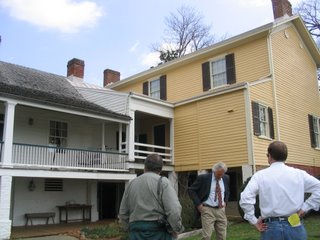
Monroe's Ash Lawn-Highland is more modest in scope and history, but still quite interesting with the right guide. (Ours was superb.) We passed on Madison's house in favor of...well, books.
Downtown Charlottesville has at least six used book stores and I hit them all. (My "Books Purchased" for March will completely obliterate previous months.) We missed the Virginia Book Festival by one day and Iris DeMent by a week (she'll be in Annapolis soon, though), but still had a great time.
Other stops included Spudnuts, a local C-ville shop specializing in doughnuts made from potatoes (tastes better than it sounds) and the Barboursville Vineyards and Ruins - an excellent winery with nearby ruins of a home designed by Jefferson for Virginia governor James Barbour. The house was destroyed by fire in 1884, but the wine's still good - we bought a couple of bottles---to go with the Spudnuts, of course.
 Monticello is quite impressive, especially if you have a good tour guide (or if you know enough to be your own guide. I do not.).
Monroe's Ash Lawn-Highland is more modest in scope and history, but still quite interesting with the right guide. (Ours was superb.) We passed on Madison's house in favor of...well, books.
Downtown Charlottesville has at least six used book stores and I hit them all. (My "Books Purchased" for March will completely obliterate previous months.) We missed the Virginia Book Festival by one day and Iris DeMent by a week (she'll be in Annapolis soon, though), but still had a great time.
Other stops included
 Spudnuts, a local C-ville shop specializing in doughnuts made from potatoes (tastes better than it sounds) and the Barboursville Vineyards and Ruins - an excellent winery with nearby ruins of a home designed by Jefferson for Virginia governor James Barbour. The house was destroyed by fire in 1884, but the wine's still good - we bought a couple of bottles---to go with the Spudnuts, of course.
Sunday, March 18, 2007
Getting Closer
Received two short story rejections this week from major genre markets, both of them containing some positives.
From one,
There's some good stuff here, but ultimately it just didn't quite work for me.
and from another,
Almost works, but doesn't quite make it.
On the plus side, neither of these rejections were form letters and both lead me to believe I'm on the right track. Something is working with each of these stories, but each also contains something that's not quite there yet.
Small steps, but steps that are moving forward.
From one,
There's some good stuff here, but ultimately it just didn't quite work for me.
and from another,
Almost works, but doesn't quite make it.
On the plus side, neither of these rejections were form letters and both lead me to believe I'm on the right track. Something is working with each of these stories, but each also contains something that's not quite there yet.
Small steps, but steps that are moving forward.
Friday, March 16, 2007
Cut It Out
Got a rejection letter yesterday, but at least it wasn't a form letter, plus it said that the story "Almost worked," so I suppose that's better than "Didn't work at all" or "Completely sucked" or "I've had more enjoyable root canals." (You have to take the small victories where you can find them.)
So I went to the next market on my list and noticed they have a 5000 word limit. Oops. My story was 5600 words. Hmmmmm.
I've cut stories before, trying the meet the word count, but the end result was never good. It probably would have been better if I'd just sent those markets different, shorter stories or just sent the longer stories somewhere else.
But I thought I'd have a go at trimming this one down. Turns out it made the story much stronger. I found several places where my first-person narrator said roughly the same thing in two different ways and a few other sentences that read like digressions. Losing those 600 extra words really wasn't that hard. They needed to be cut.
What do you say? Does cutting for word count ever make your stories stronger? It did for me in this case, but I'm thinking maybe that's not the norm. Let me know.
So I went to the next market on my list and noticed they have a 5000 word limit. Oops. My story was 5600 words. Hmmmmm.
I've cut stories before, trying the meet the word count, but the end result was never good. It probably would have been better if I'd just sent those markets different, shorter stories or just sent the longer stories somewhere else.
But I thought I'd have a go at trimming this one down. Turns out it made the story much stronger. I found several places where my first-person narrator said roughly the same thing in two different ways and a few other sentences that read like digressions. Losing those 600 extra words really wasn't that hard. They needed to be cut.
What do you say? Does cutting for word count ever make your stories stronger? It did for me in this case, but I'm thinking maybe that's not the norm. Let me know.
Thursday, March 15, 2007
Which Are You - Hunter or Farmer?
In his book on writing, Word Work, Bruce Holland Rogers talks about two different types of people/writers: Hunters and Farmers.
Hunters (who may also, Rogers says, have a touch of ADD) "are distractable, risk-taking, and restless. We may be impulsive or irritable. Our moods shift often and (to others and ourselves) mysteriously. We likely have many projects going at once, but we may finish only the ones that someone makes us finish. We change our plans all the time. What we were enthusiastic about last week isn't so interesting now because we're onto something better."
Farmers "have it together. They find it easy to do one thing at a time.... Farmers know where their tools are. They plan a project, take it step by step, and clean up when they're done. Farmer emotions have a lot to do with what's going on right in front of them at the moment. When you have a conversation with a Farmer, she is right there with you, hearing every word you say."
Rogers expounds on both Hunters and Farmers, offering suggestions to those who want to balance their Hunter/Farmer natures.
I'd say I definitely lean more toward the Hunter camp, maybe 75% Hunter, 25% Farmer. Looking at my "Current Stories" file, I have fourteen stories I've started and not finished. Yet on the Farmer side, I told myself this week that I would send one of those stories out by Friday. (It's actually going out today.) Hunting...farming...hunting...farming... Which are you?
**********************************
From the Upcoming Books I Must Have department, this from Jeff Ford.
Hunters (who may also, Rogers says, have a touch of ADD) "are distractable, risk-taking, and restless. We may be impulsive or irritable. Our moods shift often and (to others and ourselves) mysteriously. We likely have many projects going at once, but we may finish only the ones that someone makes us finish. We change our plans all the time. What we were enthusiastic about last week isn't so interesting now because we're onto something better."
Farmers "have it together. They find it easy to do one thing at a time.... Farmers know where their tools are. They plan a project, take it step by step, and clean up when they're done. Farmer emotions have a lot to do with what's going on right in front of them at the moment. When you have a conversation with a Farmer, she is right there with you, hearing every word you say."
Rogers expounds on both Hunters and Farmers, offering suggestions to those who want to balance their Hunter/Farmer natures.
I'd say I definitely lean more toward the Hunter camp, maybe 75% Hunter, 25% Farmer. Looking at my "Current Stories" file, I have fourteen stories I've started and not finished. Yet on the Farmer side, I told myself this week that I would send one of those stories out by Friday. (It's actually going out today.) Hunting...farming...hunting...farming... Which are you?
**********************************
From the Upcoming Books I Must Have department, this from Jeff Ford.
Tuesday, March 13, 2007
Get Weird
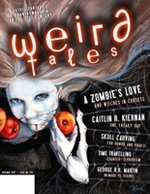
Here's a great deal, boys and girls: from now until April 31, subscribe to one year of Weird Tales for just $12. Really. I wouldn't kid around about something like that.
Friday, March 09, 2007
Playing Favorites, Installment #1
I love lists. Don't know why, but I do. For years I've kept a list of my favorite movies and have wanted to do the same with albums and songs, but never got motivated to do it.
But lately I've been listening to my collection (partly as an exercise in weeding stuff out), asking myself why I like certain songs, certain albums. So I thought it might be fun to explore some of those songs here. Even though this is the first entry, these songs are in no particular order and future music posts will probably not appear on a regular basis. Just whenever the mood strikes me.
And these aren't what I consider "the greatest" songs or albums of all time. Just stuff I like. So here's the first one:
"No Expectations" - The Rolling Stones (1968)
If you could find someone who had somehow never heard of the Rolling Stones and played them "No Expectations" (the second track from Beggars Banquet), then played them just about any other Stones song, the novice listener would no doubt ask, "That's the same group?"
Of course it's the same group. As soon as you hear him sing the first notes, it's unmistakable Jagger, yet atypical Mick: subdued, reflective, almost tender. Keith Richards quietly strums his acoustic while Brian Jones delivers a great Mississippi Delta blues slide guitar, arguably some of his best work.
"That was the last time I remember Brian really being totally involved in something that was really worth doing," Jagger reflected in 1995. Shortly after the release of Beggars Banquet, Brian Jones was found dead in his swimming pool. The song, written by Jagger and Richards, could be seen as a regretful look at life and love on the road or perhaps as Jones's epitaph.
The slide guitar brings the tune in line with not only the rest of the blues-based album, but also the band's own blues roots. Aside from Jones's slide work, the song's chord structure and lyrics are quite simple. Yet there's more going on. Nicky Hopkins (who played keyboards on several of the Stones recordings) enters after the third verse with a very unobtrusive, tasteful middle-register piano, changing the mood to something more refined, yet laced with melancholy. Hopkins pretty much stays in the middle register for the next two verses, then closes the song in the upper register with notes so delicate they sound like a stream of water running over rocks. It's the way this elegant piano line contrasts with Jones's pain-filled slide that elevates the tune to something truly memorable.
"No Expectations" was also released as a B-side to "Street Fighting Man" in the U.S.
But lately I've been listening to my collection (partly as an exercise in weeding stuff out), asking myself why I like certain songs, certain albums. So I thought it might be fun to explore some of those songs here. Even though this is the first entry, these songs are in no particular order and future music posts will probably not appear on a regular basis. Just whenever the mood strikes me.
And these aren't what I consider "the greatest" songs or albums of all time. Just stuff I like. So here's the first one:
"No Expectations" - The Rolling Stones (1968)
If you could find someone who had somehow never heard of the Rolling Stones and played them "No Expectations" (the second track from Beggars Banquet), then played them just about any other Stones song, the novice listener would no doubt ask, "That's the same group?"
Of course it's the same group. As soon as you hear him sing the first notes, it's unmistakable Jagger, yet atypical Mick: subdued, reflective, almost tender. Keith Richards quietly strums his acoustic while Brian Jones delivers a great Mississippi Delta blues slide guitar, arguably some of his best work.
"That was the last time I remember Brian really being totally involved in something that was really worth doing," Jagger reflected in 1995. Shortly after the release of Beggars Banquet, Brian Jones was found dead in his swimming pool. The song, written by Jagger and Richards, could be seen as a regretful look at life and love on the road or perhaps as Jones's epitaph.
The slide guitar brings the tune in line with not only the rest of the blues-based album, but also the band's own blues roots. Aside from Jones's slide work, the song's chord structure and lyrics are quite simple. Yet there's more going on. Nicky Hopkins (who played keyboards on several of the Stones recordings) enters after the third verse with a very unobtrusive, tasteful middle-register piano, changing the mood to something more refined, yet laced with melancholy. Hopkins pretty much stays in the middle register for the next two verses, then closes the song in the upper register with notes so delicate they sound like a stream of water running over rocks. It's the way this elegant piano line contrasts with Jones's pain-filled slide that elevates the tune to something truly memorable.
"No Expectations" was also released as a B-side to "Street Fighting Man" in the U.S.
Friday, March 02, 2007
Zodiac (2007)
I was in high school when I saw the last twenty minutes of a cable TV special (I think it was on HBO) about serial killers. This final segment of the show was devoted to California's Zodiac killer, which I thought was fascinating. I had no idea anyone had written a book about Zodiac until ten years later in 1988 when I saw Robert Graysmith's book in a used bookstore in Memphis (where I lived at the time). I took it home and read it in one night. I also didn't get much sleep that night.
Ever since then I'd hoped that one day someone would put together a good movie about Zodiac. Could David Fincher's new Zodiac be that film?
Zodiac is more a spotlight on police procedures than a conventional horror or thriller film. Don't get me wrong, there's plenty of suspense and tension, but much of it is sustained through the characters - the police, the newspapermen, the families, the surviving victims - and the passage of time as the Zodiac manhunt progresses. Critic Richard Roeper said it's like looking at Silence of the Lambs through the eyes of Scott Glenn's FBI character. Procedure is a big part of Zodiac and it's handled smartly.
One of the reasons Zodiac works so well is that Fincher knows what not to do. He doesn't spend too much time on the crimes themselves. (Many of them don't even occur onscreen.) He doesn't have the killer make long, stupid speeches or show some crazed nutcase pouring over plans in his basement at 3:00AM. The audience pretty much learns what the police/journalists learn as it happens.
Of course the problem with this is - unless you're new to the story - you know what's going to happen. But knowledge of the case did not hinder my enjoyment of the film one bit. In fact, I was impressed with how closely the film followed the book.
There's a lot to like about Fincher's version. The film is nearly three hours long but never seems like it. The acting is excellent. I can't stand Robert Downey, Jr., but I have to admit his performance is superb. (And Gyllenhaal is quite good too.) And the attention to period detail must have been painstaking.
Don't be surprised if you read several negative reviews of the film. I think that comes from Fincher fans expecting to see another Se7en or Fight Club. Those are different films and it's unfair to compare Zodiac to them. Zodiac focuses on a different kind of fear, a different type of terror. What Fincher does so well is show that those who were attacked by Zodiac were not the only victims. The slow grind of seeking information, of following dead ends, even of looking over your shoulder when you get into your car at night --- all of these things add up and affect the characters and their families. It's fascinating to see how one crazed maniac could cause such widespread fear and how people react to it. Fincher knows this and knows how to convey it.
Ever since then I'd hoped that one day someone would put together a good movie about Zodiac. Could David Fincher's new Zodiac be that film?
Zodiac is more a spotlight on police procedures than a conventional horror or thriller film. Don't get me wrong, there's plenty of suspense and tension, but much of it is sustained through the characters - the police, the newspapermen, the families, the surviving victims - and the passage of time as the Zodiac manhunt progresses. Critic Richard Roeper said it's like looking at Silence of the Lambs through the eyes of Scott Glenn's FBI character. Procedure is a big part of Zodiac and it's handled smartly.
One of the reasons Zodiac works so well is that Fincher knows what not to do. He doesn't spend too much time on the crimes themselves. (Many of them don't even occur onscreen.) He doesn't have the killer make long, stupid speeches or show some crazed nutcase pouring over plans in his basement at 3:00AM. The audience pretty much learns what the police/journalists learn as it happens.
Of course the problem with this is - unless you're new to the story - you know what's going to happen. But knowledge of the case did not hinder my enjoyment of the film one bit. In fact, I was impressed with how closely the film followed the book.
There's a lot to like about Fincher's version. The film is nearly three hours long but never seems like it. The acting is excellent. I can't stand Robert Downey, Jr., but I have to admit his performance is superb. (And Gyllenhaal is quite good too.) And the attention to period detail must have been painstaking.
Don't be surprised if you read several negative reviews of the film. I think that comes from Fincher fans expecting to see another Se7en or Fight Club. Those are different films and it's unfair to compare Zodiac to them. Zodiac focuses on a different kind of fear, a different type of terror. What Fincher does so well is show that those who were attacked by Zodiac were not the only victims. The slow grind of seeking information, of following dead ends, even of looking over your shoulder when you get into your car at night --- all of these things add up and affect the characters and their families. It's fascinating to see how one crazed maniac could cause such widespread fear and how people react to it. Fincher knows this and knows how to convey it.
Thursday, March 01, 2007
Adam Kingsley Smith

If you're going to be in my neck of the woods on Saturday, March 3 you owe it to yourself to drive, walk or crawl to the Severna Perk coffee house to check out Adam Kingsley Smith. Adam's a really cool singer/guitarist who's got some great stuff going on, including several tunes he wrote. As he mentions on his MySpace page, he's got some strong Bob Dylan/Johnny Cash influences. He'll be performing Saturday from 4:00-5:00PM. And it's free. Check him out.
Severna Perk
545 Benfield Rd
Severna Park, MD 21146
Subscribe to:
Posts (Atom)