Tuesday, January 29, 2013

Now I've Done It....

I finally broke down and bought a subscription to Hulu Plus, primarily to have access to many of the Criterion Collection titles I've yet to see, but I'm discovering the channel has much more to offer. (Thanks, Orangerful, for a free 3 month subscription as a birthday present!) This channel will keep me quite busy, much to the displeasure of my online instructors this quarter. 

If you need a little Hulu Plus incentive, Paste has posted a list of the 50 best films streaming on Hulu Plus. Enjoy!  

Thursday, January 24, 2013

Eclipse Series 25: Basil Dearden's London Underground and the Eclipse Sets in General


Eclipse Series 25
Retail $59.95
Amazon $49.99

For those who may not know, Criterion came out with an Eclipse line of films in 2007, a series of boxed sets of affordable DVD editions featuring hard-to-find, forgotten, or somewhat obscure films. These films do not include either the extras (other than some liner notes) or the level of remastering film lovers have come to expect from the regular Criterion Collection titles, although the transfers are quite good. (On a purely practical level, the films come in individual slim cases in a box that’s open at both the top and bottom, so be careful in handling these sets.)

Each set usually focuses on a theme, a style, or a director. Two or more films (usually three or four) are included in each set and sets are priced accordingly. You can find a complete list of the Eclipse series here.   

I found this Series 25 set at a Borders that was going out of business a few years back and decided to take a chance on it (since all the DVDs and sets at that point were 60% off). It turned out to be a risk worth taking. 

Basil Dearden (1911-1971) directed films at West London’s Ealing Studios during the 1940s and 50s before deciding to tackle more controversial subjects on his own, subjects he knew the studio would never touch. The four films in this Eclipse set are enclosed in an atmosphere of post-WWII complacency while looking ahead to the cultural changes that would explode in the 60s. While these particular tones are present in all of these films, each title focuses on a particular point of controversy, in most cases, well before their intended audiences were ready for them. 


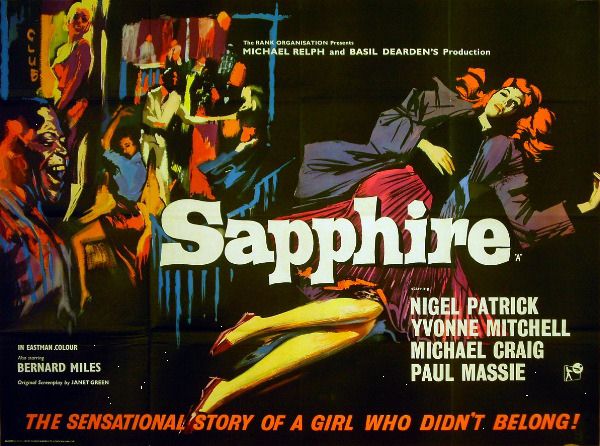
Sapphire (1959) 92 min. 
The body of a beautiful young woman named is found dead at the opening of the film, leading police on a winding path for her killer. Sounds pretty routine, but Sapphire (the only color film in the set) is a police procedural focusing not only on a murder, but also post-war racial conflict. The film contains many good scenes, but as a police procedural, it’s a bit stiff and heavy-handed. Yet the cinematography and performances are quite good. Remember that Dearden is trying to make his 1959 audience see something they either hadn’t or didn’t want to see.  


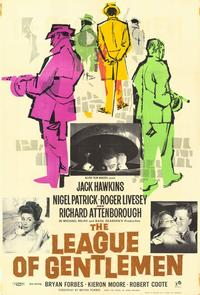
The League of Gentlemen (1960) 116 min. 
The lightest in tone of the four films, The League of Gentlemen is a wonderful heist movie and contains the least amount of social commentary. That doesn’t, however, mean it’s without social commentary. Former Army Lieutenant-Colonel Norman Hyde (Jack Hawkins) secretly assembles a group of ex-army officers (a la And Then There Were None Style), each being enticed to attend a meeting via an envelope containing an American paperback entitled The Golden Fleece, half a 5£ note, and an invitation from an organization called “Co-operative Removals Limited.” 

This odd “band of brothers” - all of them bored, disenfranchised veterans with checkered pasts - makes this sort of a pre- Oceans-11 (which also came out in 1960) type of film. It’s a lot of fun. Any time you can see Hawkins (one of my favorite British actors), do so.

Victim (1961) 100 min.
Victim has the distinction of being the first English-language film to use the word “homosexual.” As such, the film was considered highly controversial in England and banned for a brief time in the U.S. You have to remember that homosexuality was actually a crime in England until 1967. That knowledge gives Victim a lot of power and displays Dearden’s courage in making it. 

Dick Bogarde plays Melville Farr, a respected barrister with a secret life that’s about to be exposed by a blackmailer. The film would stand on its own as a good mystery drama even without the then controversial element. Again, seen in 2013 it might be hard to understand what the fuss was all about, but put yourself in that era, and the film becomes frank, honest and gutsy.  


All Night Long (1962) 91 min.
All Night Long takes place during a single rainy night of nearly non-stop jazz as well as non-stop jealousy and back-stabbing. A rich London music promoter decides to throw a party for jazz musician Aurelius Rex and his new bride Delia, a retired jazz singer. Although Delia is content to retire from the spotlight and spend time with her new husband, an ambitious drummer named Johnnie Cousin (Patrick McGoohan from the TV show The Prisoner) wants her to headline his new band. The film is something of a retelling of Shakespeare’s Othello in the jazz world, and is also played out in a house that acts somewhat like a stage: enclosed, often claustrophobic and tense. All Night Long offers some very good scenes and some nice jazz, featuring cameos by jazz legends Dave Brubeck and Charles Mingus.

While I greatly enjoyed this set, and look forward to watching all these films again in the coming years, I’d be very hesitant to take a chance on buying another Eclipse set. The guys on the Criterion Cast podcast (You can find them on iTunes.) sometimes report that some of the Eclipse films air on the Hulu Plus channel, which gives you an opportunity to watch before you buy. Or your public library may have some of these sets. (Our system currently owns four sets: Lubitsch Musicals, Rossellini’s History Films, Alexander Korda’s Private Lives and the First Films of Akira Kurosawa.) If Criterion’s purpose in producing these sets (after making a profit, of course) is to bring an awareness of these films to film lovers (or even the curious), the retail prices are still pretty high. 

I don’t know how well these sets are selling, but for several months, Criterion produced no new Eclipse titles. Finally, a few days ago, Criterion announced the April 2013 release of Eclipse Series 38: Masaki Kobayashi Against the System (four discs priced at $59.95 retail). (For more information on both the Eclipse sets and all Criterion releases, I highly recommend the Criterion Cast.)

I would never buy any of these sets at full price sight unseen, but I know there are probably people who do. If I saw two out of four films of a set on Hulu Plus (or somewhere else) and liked them, I might buy the set. But if the sets were more reasonably priced and I’d only seen (and enjoyed) one of the films, I’d be more likely to buy the set. (As far as I know, the movies in the Eclipse sets are not available individually.)

Or maybe I’d be more enticed to buy more sets if Criterion had some type of club or incentive in place. Maybe for every regular DVD or Blu-ray purchase, Criterion could give a coupon for a certain percentage off the price of an Eclipse set. I hope the Eclipse line isn’t going away, but I also hope accessing them gets easier and/or more affordable. If they do, you’ll see more of them reviewed here. Based on the Basil Dearden set, I’m definitely interested in more Eclipse sets.   

Tuesday, January 22, 2013

Revisiting Being John Malkovich 12+ Years Later


It’s always a bit dangerous to revisit a movie you saw and enjoyed 12+ years ago. Until you’ve done it, you’ll never know whether the film, the times, or you (or all three) have changed in ways that make the film no longer enjoyable. 

I first saw Being John Malkovich in the basement of an apartment building in downtown Baltimore in 2000. My sister-in-law was living there at the time and told me they had “sort of a “movie theater” in the basement, so I went. Neither the print nor the sound were very good, but I watched the film and enjoyed its inventiveness, weirdness and craziness. I’d never seen another film quite like it. 


Having had such good memories of the film, I bought the Criterion Collection Blu-ray release a few months ago (at a Barnes & Noble half-price sale) and kept it on the shelf, waiting for just the right time to revisit it. Cindy and I watched it a couple of nights ago (she for the first time) and I realized that while the film hadn’t changed, both the times and myself had. 

(SOME SPOILERS AHEAD)  

I won’t go into the plot of the film. If you’ve read this far, you’ve probably already seen the movie and don’t need it summarized for you. I will talk about a few spoilers, so if you haven’t seen it, read no further. 

Times have changed. While maybe we can’t really get inside someone’s head - at least not in the way the characters in the film do - we can pretend we’re someone else for 15 minutes or longer. (We may not necessarily end up beside the New Jersey Turnpike afterwards, but it might feel like it.) Millions of people via various Internet, gaming and other tech methods can easily pretend they’re someone else, living out parts of their lives with a new identity. For limited periods of time, that can be fun. We basically do that when we’re watching a movie, playing a video game, etc. Then we go on with life. 

Puppeteer Craig Schwartz (John Cusack), however, isn’t content with just a few minutes. Craig wants to manipulate/enter the body of John Malkovich for his own selfish purposes. In fact, Craig’s wife Lotte (Cameron Diaz) and would-be girlfriend Maxine (Catherine Keener) are also in this venture for selfish reasons. That would be bad enough, but then there’s the whole houseful of senior citizens led by Dr. Lester (Orson Bean) who also want to inhabit the body of Malkovich. 

Don’t get me wrong: I greatly admire the enormous talents of director Spike Jonze and writer Charlie Kaufman for making all of this work and the film’s utter brilliance. We could talk for hours about the significance of Craig’s career as a puppeteer, issues of control (over puppets and people), connecting with other people in relationships, searches for love and understanding leading to erratic behavior, the significance of Floor 7 1/2, and much more. Yet, for all its humor and insane creativity, I’m left with a feeling of incredible sadness. 

By the end of the film, Lotte and Maxine have manipulated people for selfish reasons and (seemingly) suffer no consequences for it. Craig certainly deserves consequences for his selfishness and receives them. The person you feel the most sorry for is Malkovich (the character), the ultimate victim who has been violated beyond belief, but since it’s Malkovich (the actual person), a fine actor we’ve come to laugh at as much as admire, we tend to overlook his victimhood.  

Maybe that’s Jonze’s point. Maybe Jonze and Kaufman are telling us that this is a world without justice, at least at this point, that people do “get away” with selfish behavior while the victim(s) get no justice. Maybe the times we’re in now, with our inability to be ourselves without adopting (or obsessing over) the identity of someone else, damn the consequences, are the logical conclusion of this film. If so, we’ve reached a sad, sad point. 

Don’t misunderstand: I’m not against video games, the Internet, fiction, or imagination. But I see in many of the characters in Being John Malkovich a sense of pride, entitlement and utter selfishness, all without conscience, all without consequences, and that makes me incredibly sad. Sure, I laughed in many places while watching this film, just like I did 12+ years ago, but as the credits rolled, I was left with a feeling of emptiness, a sense that our fallenness has reached a new place. 

Being John Malkovich is a brilliant film, but it's not one I plan on watching again.  

Monday, January 14, 2013

Golden Globe Results, or, Affleck's Revenge


I never watch 'em, but the Golden Globe awards were handed out last night. Here's the list of winners only, and the list of winners and nominees. Ben Affleck may have been slighted in the Best Director category for the Oscars, but he snagged Golden Globes for Best Director and Best Drama for Argo

A few things I learned from the Golden Globe results:

It would seem I really need to check out the TV show Homeland, which picked up a few trophies. 

Regardless of the number of awards it wins, I will not be seeing Les Miserables

Oh, and by the way, don't mess with Maggie Smith.

The Oscars will be presented on Sunday, February 24, giving me plenty of time (I hope) to see the nominees I haven't yet seen. 

Saturday, January 05, 2013

Brick (2005) Rian Johnson


Brick (2005) 
Directed by Rian Johnson
Joseph Gordon-Levitt
Lukas Haas
Rated R, 110 minutes

Brick is one of those films that probably should never have happened. But I’m so glad it did.

Brendan Fry (Joseph Gordon-Levitt) is a Southern California high school student who discovers his ex-girlfriend Emily lying dead at the edge of a sewage tunnel. Although their relationship didn’t end well, Brendan makes it his mission to find out who killed Emily. Doing so will take him on a quest through various social groups in his school, an unrelenting vice principal (played by Richard Roundtree, the original Shaft), a gauntlet of tough guys, and ultimately landing him face-to-face with the local drug lord referred to as “The Pin.”  

The film owes a lot everything to film noir, a genre that was already dead before any of these actors were even born. Noir has its own rules and most of them revolve around character and style. The makers of Brick have obviously spent a lot of time and effort getting those elements right, although the film’s scenes take place mostly in high school hallways and parking lots rather than smoke-filled bars and jazz joints. 


Like lots of films noir, Brick is filled with fights, but fights adorned with clever noir dialog. Just before one fight with the school’s top football player, Brendan taunts the jock, who always responds with, “Yeah?” Brendan finally has enough: “There’s a thesaurus in the library. Yeah is under ‘Y.’ Go ahead, I’ll wait.” And just before another fight with a stoner: “Throw one at me if you want, hash head. I’ve got all five senses and I slept last night, so that puts me six up on the lot of you.”

Since noir is more concerned with character and style than it is with plot and nice, neat resolutions, the average viewer might walk away disappointed or confused. Brick certainly has a plot and a resolution, but I don’t think those are director Rian Johnson’s primary concerns. Classic noir (generally from the post-WWII 1940s to roughly 1958) was full of character and style and sometimes contained well-structured plots and resolutions, but not always. (See The Big Sleep from 1946 and tell me what sense you can make of that.) Films that are more neo-noir (Chinatown, Body Heat, even more current sf-noirs like Dark City and Donnie Darko) have an even darker, often postmodern tone, rarely giving audiences full resolution or hope. Brick is a perfect marriage of the style, speech, mannerisms and motivations of classic noir in a neo-noir setting. Again, this shouldn’t work, but it does, largely because everyone involved in the film takes it seriously. There’s irony here, but little other humor, no tongue-in-cheek, no spoofing and no gags. To state it simply, the plot and resolution of a noir film doesn’t have to be believable to the audience, but it’s essential that the characters believe it. In Brick, they do, even if the audience doesn’t. The level of courage and faith required to make such a film in 2005 is tremendous. If you buy into it, the film works. If not, I wouldn’t worry too much about it; there are (unfortunately) few films out there like Brick

Brick was made for about half a million dollars and grossed over $2 million at the box office. Not bad. Not great, but not bad. I don’t know the DVD sales figures, but either from a monetary or an artistic viewpoint (or maybe both), Johnson went on to make 2008’s The Brothers Bloom and the recent hit Looper. If Brick is any indication of Johnson’s talent and vision, I’ll be glad to follow him for the long haul. Brick is definitely worth two hours of your time and is currently streaming on Netflix. 

4.5/5

Friday, January 04, 2013

Terry Gross and Quentin Tarantino Get Violent


Terry Gross recently interviewed Quentin Tarantino on NPR's Fresh Air, where they talked about Tarantino's new film (which I have not seen) Django Unchained. You can listen to the interview (about 35 minutes) here or download it from iTunes. 

Things get a little uncomfortable in the interview; not out of control, but clearly uncomfortable for both Tarantino and Gross. I'll let you decide for yourself and I certainly want to listen to the interview again, but I believe Gross - normally a rock-solid interviewer who does her homework - drops the ball by not preparing for this exchange as well as she could have (and normally does). 

Regardless, the interview can and should spark a good discussion of the differences between film violence and real violence. Definitely worth a listen and a future blog post (when I have more time!). 

Wednesday, January 02, 2013

Malick's New Film, Edelstein Slams Les Mis and a Few Personal Film Stats


First, from my less-than-accurate statistics, I believe I watched 90 films in 2012 (which is really not very many), 68 of them for the first time. The film I saw this year that I’ve seen the most is It’s a Wonderful Life, (which I’ve seen at least 25 times), followed by Alien, which I estimate to have seen eight times. 

For Criterion Collection fans, Criterion titles accounted for 16 of those films.

And something I don’t think has ever happened before, and didn’t plan this time: the first film I watched in 2012 was also the last film I watched in 2012: The Lord of the Rings: The Fellowship of the Ring. I received the boxed set of extended Blu-rays last Christmas and started the new year with the first film. After seeing The Hobbit, Cindy and I wanted to revisit the trilogy, so I saw The Fellowship again to close out the year. 

I haven’t seen Les Miserables and do not plan to. My suspicions were confirmed by David Edelstein, on NPR’s Fresh Air, who said, 

“What I saw onscreen was a transcendentally tasteless bombardment, an absolute horror show that, in a just world, would send people screaming from the theater. It is ghastly from first frame to last.”

Instead, I’m waiting for this new film from Terrence Malick, To the Wonder. Watch the trailer here

Monday, December 31, 2012

Just a Few Before We Go.....

The problem with making and posting any "Best of the Year" lists before the true end of the year is the possibility that you'll discover more films that deserve to be on the list. While only one of these films I saw after I posted my Best Films list is really exceptional, I enjoyed all three.


I wasn't aware of it at the time, but I watched three Steven Soderbergh films in as many weeks. (I guess that makes me a Soderboy?) While Haywire is not one of his best films, it was enjoyable on several levels. Sure, it's mainly an action flick with its share of action flick problems, but it was still fun to watch. I especially appreciate the fight scenes: there's no fancy camerawork, lightning-fast cuts or in-your-face shots. Soderbergh just sets up the camera and records the action. Gina Carano may not be the greatest actress, but her fighting and stunts are amazing. (Of course it helps when you're a mixed martial artist.)


Basil Dearden's Victim from 1961 takes on homosexuality in the context of blackmail, a very taboo subject for its time and delivers a pretty good dramatic mystery with some noir elements. If you've never seen any of Dearden's work, you're missing out. Check out the Criterion Collection Eclipse Series 25: Basil Dearden's London Underground for four of his films, all of which are good. 


Finally, there's Jim Jarmusch's Down By Law, a film that I hope to discuss more in a few days. You'll hear some people say that Jarmusch's films are too slow, or that they don't go anywhere, but I would disagree. It's one of those films that may not seem like much while you're watching it, but as you think about it and especially its characters, it starts to open up for you. Wonderful black and white cinematography, too. Again, more on this one later. 

Happy New Year, everyone! 


Friday, December 28, 2012

Stop Making Sense (1984) Jonathan Demme


Directed by Jonathan Demme
David Byrne - vocals, guitar
Chris Franz - drums
Tina Weymouth - bass
Jerry Harrison - keyboards, guitar
88 min.

Extras:
Commentary by Jonathan Demme and the four band members
1999 Press Conference celebrating the film’s 15th anniversary (just over one hour)
David Byrne Interviews...David Byrne (5 min.)
Montage (3 min.)
Bonus Songs “Cities” (4 min.) and “Big Business/I Zimbra” (8 min.)
Storyboards
Big Suit (text)
Trailer (2 min.)
Previews (6 min.)

Pauline Kael, in her review, said “Stop Making Sense makes wonderful sense.” It does and it doesn’t.

Monday, December 24, 2012

Jack Klugman (1922-2012)

One of my favorite actors, Jack Klugman, passed away today at the age of 90. Most people remember Klugman from the television show The Odd Couple and later, Quincy, but I'll always remember him for his four appearances on The Twilight Zone. (Only Burgess Meredith appeared in as many episodes.)
Klugman appeared in these episodes, all of them good, especially the first:


A Game of Pool
A Passage for Trumpet
Death Ship
In Praise of Pip


The Naked Kiss (1964) - Samuel Fuller


The Naked Kiss (1964) Directed by Samuel Fuller
Black and white, 90 minutes
Criterion Collection DVD and Blu-ray editions
Special Features and Extras:
Constance Towers interview (28 min.)
The South Bank Show: "Sam Fuller" (32 min.)
Cineastes de notre temps (featuring Fuller discussing film, in English, 24 min.)
Cinema Cinemas (more Fuller discussing his career, in French and English with subtitles, 13 min.)
Theatrical Trailer (2 min.)
24-page booklet 

The Naked Kiss is a strange little film, made even stranger when you consider that it was released in 1964, the same year that gave us Beatlemania, My Fair Lady, and the Ford Mustang. We might consider it somewhat tame today, but for 1964, The Naked Kiss was a shocking, defiant, in-your-face film that dealt with then-taboo topics of prostitution and molestation in a bold, unflinching manner. 


Constance Towers plays Kelly, a prostitute running away from her former pimp after a highly charged opening scene that grabs your attention. Kelly steps off a bus, landing in the small All-American town of Grantville. After spending the night with Griff, a local cop, Kelly decides to go straight, working for a local hospital for handicapped children. Eventually Kelly meets and falls in love with one of the pillars of the community, J.L. Grant, causing great disturbances among the locals. 


Of course the previous paragraph sounds absolutely preposterous. Yet Fuller makes it work, showing the audience the seedy underside of small-town crime and making you believe that Kelly is caught between trying to do the right thing and utter anguish. Most of the time you’re unsure whether you’re witnessing a video tabloid or trapped inside a surreal nightmare. Yet Fuller insists on keeping the viewer focused on this noir-ish low-budget melodrama. The Naked Kiss a strange, nightmarish world that often creeps you out, but it’s nearly impossible to look away. As such, I think of it as a sort of precursor to a later (and much more disturbing) film like Blue Velvet


Yet The Naked Kiss is ultimately a film of hope and redemption, even if some of those aspects seem a bit forced at the film’s end. Towers does a great job of pulling off the role of Kelly, one of the strongest female characters I’ve seen from this era of film, but it’s Fuller’s unrelenting refusal to sugar-coat the story that makes The Naked Kiss potent.  

I’ve only seen one other Samuel Fuller film before this, Pickup on South Street, a great noir film from 1953 starring Richard Widmark, but it’s now obvious that I clearly need to see more. Perhaps the Eclipse Series 5: The First Films of Samuel Fuller...  

4/5

Friday, December 21, 2012

Best of 2012 Lists for Your Viewing Pleasure


Thanks largely to my good friend Kelly, here are a few of the Best Films of 2012 lists floating around, many of which are now on DVD or streaming (or still in theaters). Enjoy! 


And finally, some Great Movies You Might Have Missed from IGN.

Thursday, December 20, 2012

Soon this blog will cover only movies and television. More coming in 2013.

Tuesday, May 25, 2010

The Next Stop

At least for now, the blog has moved to this location.

Saturday, May 22, 2010

Movin' Out


This blog will soon be moving to a new location. Stay tuned!

Tuesday, May 18, 2010

Where Have All the Westerns Gone?


I weed every day. Not outdoors in the yard or garden, but in the library, specifically Adult Fiction. We have a pretty small section of Westerns, as I suspect most libraries do these days. A very dedicated few are keeping that section going, checking out the same 20 or 30 titles over and over. Zane Grey and Louis L'Amour are mainstays with a few Elmer Kelton and Elmore Leonard titles thrown in, but otherwise the Western is dying a slow death.


Maybe you have to have been from an older generation to truly appreciate a Western novel or story. I've only read a handful of Westerns but I saw lots of Western movies as a kid. Maybe that's a generational thing, too. When I was a kid, Gunsmoke was nearing the end of its 20-year run on television. I watched it from time to time, but even as a kid, the show struck me as somewhat sanitized, a little too squeaky-clean for the Old West.


In sharp contrast were the Western movies. I grew up in the 60s and 70s, watching Clint Eastwood as The Man With No Name and some of the more non-traditional Westerns like High Plains Drifter, Pat Garrett and Billy the Kid and A Fistful of Dynamite. I didn't even know about the earlier tradition of classic Westerns like Stagecoach, She Wore a Yellow Ribbon, My Darling Clementine, The Searchers and tons of others.

So I suppose I came to the table after most of the good cards had been dealt. Later I understood the attraction (and sometimes, even, the genius) of the American Western film, even though I largely ignored Western Fiction. Maybe I should make it a point to check out one of those Louis L'Amour books and see what the fuss was all about. Before they're all gone.

Sunday, May 16, 2010

The City and the City (2009) - China Miéville


While I confess to never having read a China Miéville novel before The City and the City, I have read a few of his short stories. From those I came away with the sense that one of Miéville’s favorite themes is the uneasy, sometimes foreboding feeling one gets after realizing that the forces in this world that can’t be seen are more unsettling than the ones we can. The City and the City is, in a very fundamental way, about this feeling, but it is so much more.

The novel begins with a detective named Borlú assigned to solve the murder of a young woman in his home city of Beszel. No problem, right? Ah, but Beszel co-exists in the same place as another city, Ul Qoma. The citizens of one city have been trained for generations to ignore or “un-see” anything that might go on in the other city. Each city has its own police force and judicial system, but anyone caught “crossing over” into a place they don’t belong or participating in an activity that would cause one to “recognize” the other city comes under the jurisdiction of the Breach, a powerful entity that seemingly sees all, knows all, and tells nothing.

If it all sounds ludicrous, trust me that Miéville is talented (okay, brilliant) enough to make it all work. Even when Borlú is granted permission to investigate the case in Ul Qoma, I thought the whole thing was going to fall apart, but Miéville clearly has it all figured out in a way that, if you think about it, makes perfect sense.

The easy danger in reading The City and the City is in trying to turn everything into a metaphor. Yes, anyone who’s lived in a city (or even visited one, for that matter) knows that certain people can be ignored or un-seen, that the culture of a city sometimes exists on such behavior, but Miéville is doing far more than tossing metaphors around. He’s showing us ideas, big ideas having to do with philosophy, perception, motivation, manipulation, behavior control, mind control and much more. And, by the way, it’s a darned good detective tale.

The City and the City is a labyrinthine tale that is the ultimate “You can get lost in it” novel. Yet reading it is anything but a frustrating experience. This is the most mind-expanding (and the best) novel I’ve run across this year. There’s a reason it’s been nominated for a long list of awards: it’s stellar. Read it.

Friday, May 14, 2010

Now What?


I've have much more to say about China Miéville's novel The City and the City next time, but for now, I'm in a quandary: The novel is so good and resonated so well with me that just about anything I read after it is bound to be a major disappointment. Maybe the thing to do is read something at the polar opposite of this book, something completely goofy or maybe a short story collection.

So what book(s) have you read that you finished, thinking, "That's it. Nothing will ever top this one!"?

Sunday, May 09, 2010

Let Your Dog Organize Your NetFlix Queue


It's early on, but my dog is becoming quite the critic. We've had Broadway a little over a month and he's already making his movie tastes known to us. A couple of nights ago I tried watching Superman Returns. About 20 minutes into it, he started whining, so I stopped the movie and took him outside for a walk.

Last night I watched another hour of the film before I got bored with it. Broadway was way ahead of me. He got off his bed in the basement (in front of the TV) and went upstairs to his much less comfortable blanket.

Yet he stayed with me for every minute of the Wim Wenders film Wings of Desire (1987). (Maybe he picked up some German while he was racing?) I may just put him in charge of my NetFlix queue. I just shouldn't be too surprised if I see Space Buddies show up in the mail one day.

Friday, May 07, 2010

This is How It's Done


It astonishes me in this economy how few businesses get it right. Money is tight and when people do have a little bit that they can spend on entertainment (or anything, for that matter), they want it to count for something. People want to walk into a clean, well-maintained, well-stocked store run by friendly, knowledgeable staff who make you feel special. They want a good experience, they don't want to be intimidated or talked down to or jerked around.

The staff at Third Eye Comics in Annapolis know this. I can't think of any store that I've been in lately that's as well run as Third Eye. The entire store is spotless. Not only that, it's organized and has a natural flow to it. There's no wasted space, yet everything is in plain sight, no books hidden behind books, no stacks of merchandise littering the floor, and not a speck of dirt anywhere.

And these guys and gals know their stuff. On my initial visit, the store manager (one of the friendliest, most engaging guys I've ever met) asked me what type of comics/graphic novels I was interested in, made a few no-pressure suggestions and said to let him know if I had any questions. I did have a few and he answered them expertly.

Well, that can happen in lots of places, right? But the next time I came in, he called me by name, named the titles I'd bought previously and asked how I liked them. He does that every time. And he does it with everybody. The guy's memory is incredible.

During Free Comic Book Day last week, Third Eye was a madhouse. Yet the staff had the day exceptionally well planned out and never looked the least bit stressed or shaken. What was even more impressive was walking into the store this week, just days after FCBD. The shelves were completely restocked with incredible stuff. I remember seeing guys checking out on FCBD with several big ticket items. (I bought a fairly big ticket item myself.) Every one of those items had been reordered and were on the shelf.

These guys know their product. They know customer service. That's why they've been nominated for The Will Eisner Spirit of Comics Retailer Award, honoring the best comic shops in the world. That's right: in the world.

If you want to see a comic shop done right, heck, if you want to see a business done right, take a drive over to Third Eye Comics.